PearlCast › Episode 21
Episode 21Aug 29, 202511 min
Paul Stewart, Ambry Hill
About this episode
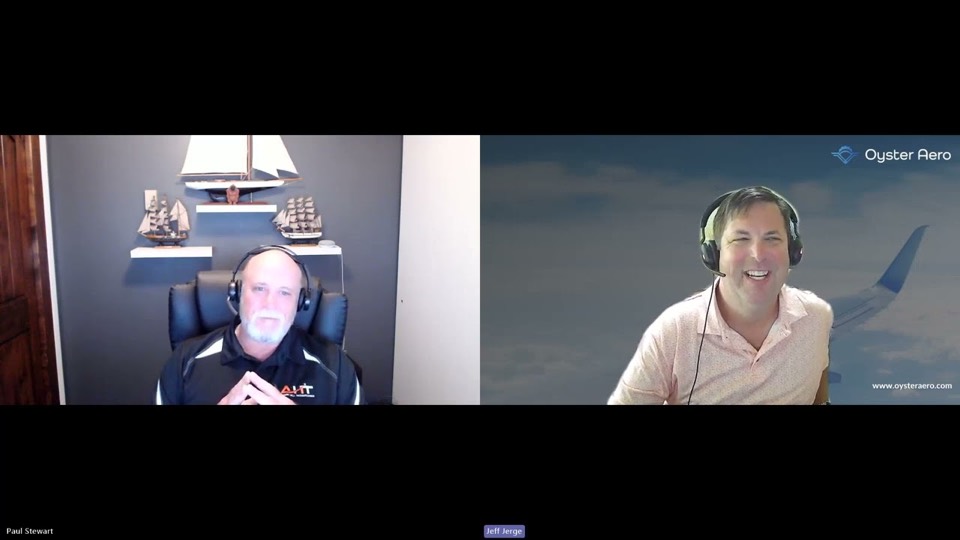
We are joined Paul Stewart of Ambry Hill for this episode! Paul walks us through the founding of Ambry Hill, talks us through some of the growth stories along the way and hints towards some future projects. Check out our latest clip with Paul!
Transcript
Read the full transcript
From the episode's captions, as published. Words that can't be made out are marked [unclear].
Welcome to the Oyster Aero PearlCast, where we sit down with founders and leaders shaping the aviation industry. From freshly formed startups to the biggest names in the sky, this episode is brought to you by our friends at Turbo Resources in Phoenix, Arizona. Now operating in 450,000 square ft of state-of-the-art warehouse space, Turbo continues to keep the aviation industry flying and is actively buying material. Now, we hope you enjoy this episode. Hello everyone. I am Jeff Jerge, [unclear] for Oyster Aero, and I'm here with my good friend Paul Stewart from Ambry Hill. How you doing, Paul? I'm doing great, Jeff. Thanks for having me. Yeah. Uh, how's your summer going so far? Summer is going fantastic. Things are rocking and rolling as usual. Yeah, always, huh? Um, so as you know, these podcasts are usually with founders and uh or early stage um executives. So I wanted to talk a little bit about what you guys are doing at Ambry Hill, a little bit about your story. Um, so let's start at the beginning. When did you begin AHT?
That's a sort of a loaded question. I I started developing the business plan for AHT back in oh gosh 2014 and uh started developing the the products in 2016 and then officially launched the business in 2018. Uh so yeah, it's been a while. We started out with a Vista Quote product. Got it. Okay. And so with Ambry Hill, you have Vista Quote and Vista Suite. So what are the Yeah. What are the differences between those? That's a great question. So Vista Quote is a a sales uh automation tool that can uh capture and automate the inbound RFQ process for sales teams. Uh it also automates the responses uh and you can even you know accept the uh the customers can accept the quotes online. So it's kind of a cradletograve uh sales automation tool that can sit over top of an existing business software package or can be used independently. Then our Vista suite program which we started developing in 2020 uh is a full endtoend ERP and MRO. So it can handle 145 operations, light aircraft maintenance, light manufacturing, parts trading, inventory management, the whole nine yards.
Got it. Got it. Now, um, you're the first series of some ERPs that, um, you know, I'll probably be talking to. So, let's go back to 2014. I mean, forever there was, you know, one ERP. Um, we won't name them, but but there's just been there's been such an explosion in the space of of players, and you were one of the earlier ones. So, talk me through like that decision and then uh to to kind of start and and and sort of take that on. You know, it was one of the hardest decisions I ever made in my life. Um so, I had been working for one of those ERP companies and uh came over to Minnesota and uh was working at Worthington Aviation uh as their COO for many many years. And you know I as a user I just started getting more and more frustrated with what options were available on the market uh and uh you know kind of how the the user community was being held hostage a bit. So I started down the path of trying to lay out the business plan and started talking to some pretty influential people uh and getting advice and guidance. Uh and then I had an epiphany that I would start the Vista product line uh first and that idea actually came from a mobile app called Triet uh where it captures your travel information out of your emails. And I thought, you know, I'm going to I'm going to make Triet for aviation and just do it with RFQS. So that was where it actually started. But um yeah, it was tough for the first few years. I was working at night from 10 uh 10 p.m. at night until about 4:00 a.m. in the morning working with my developers and then I would make an hourlong commute.
Uh get to work at 7, you know, and then come back, get home at 700 p.m. at night. Uh and I did that for two two and a half years with, you know, average of three hours of sleep a night. So it was it was not an easy decision to make that leap. Yeah. Wow. We know what that's like. Um, so, so, um, well, that's that's good. And, and then I guess as as as you build out the Vista Suite products, I guess, um, what's been the So, what's been the hardest thing? Because it seems like back in the day if somebody wanted to leave their ERP system, it was a major decision, you know, major investment and all that. And it seems like now that things are more cloud-based, maybe not so much. I mean, how how how easy is it to shuffle that around? That's a that's a very good question. So, over the years, there's been a variety of tools that have been developed to make data migration and things like that easier. Uh, the competitive landscape in the ERP sector for the premium niche industry that we're in, aviation specifically, has really, to your point, blossomed over the last several years. I think we now have seven choices on the market. So, it's much easier for a company to uh make those types of decisions and move from one system to another even if it's in the ER the ERPs in the cloud. And one of the reasons is because of the competitive marketplace. It's not as expensive as it used to be. That's because of the tools developed. That's because of the the competition, you know, amongst all of us trying to win the business. But also, you know, look, especially in aviation, ERPs were not the whole migration part was not well known for for quite a long time. So, there wasn't a lot of expertise in moving that one system to another. And now there's uh plenty of resources that people can draw on. So, I don't see it as hard as it used to be. Um, right. You
know, it's it's still not it's still not easy, but it's certainly not what it used to be back when I was implementing old school systems. Right. Right. And then what about migrating, you know, um the people from the the old system to the new because you and I both know once we know something really well, there's some change hesitancy there or hesitance of change, I guess. So, um how is it like getting in an electric car when you've been on a horse and buggy? Is that kind of the In some cases, that's that's actually a really good analogy. In some cases, yes, change management is one of the hardest things uh for for people. And the key there is to find a system that's easy to adopt, familiar, uh but in familiar in a way, not so much that it's old school, but familiar in how they're doing their business today. Um and uh the bottom line is that people are resistant to change. They're just like, you know, water and electricity. they'll take the path of least resistance and that is staying with what they know. So that's something that you'll never be able to program your way out of human behavior.
Uh it's always going to be challenging for change. Um even if you just are changing the donuts you get in the morning, somebody's liable to gripe. Right. Right. Right. It's just going to be part of the nature of of the business. Yeah. So it is a challenge. But hopefully the other side of that is all the efficiency that you gain, the digitization that you gain, all that stuff. I mean, I remember looking at some stuff with mobile you guys were showing me that you can, you know, take photos of stuff on the floor and have it all sync up immediately. And yeah, um just some really neat features. Yeah, that that is definitely key to um our system having that mobile capability but also some of the the the way the user interface works. We try to minimize the the steps, minimize the keystrokes. We try to keep all the screens looking very similar so that if you learn how to do something in one part of the system, you know how to do it in another part too. Um and that's key that uniformity is very very key. So that can make user ad adaptation uh much faster. Um and and our users so far have really agreed with that.
Awesome. Awesome. So without sharing your product development roadmap, what's ahead? What do you think the next year or two looks like in the space? I guess. Yeah. Uh we've got some pretty exciting things that are coming out. You know, of course, everybody is embracing AI. uh we have several R&D projects going on right now centered in the AI sector and um our approach is is has consistently been different than our competitors. As you know, we were the very first company to introduce AI in any fashion in the business process for aviation companies and that was by reading and interpreting the emails that that are are captured. Um and uh we're going to be the first in a couple of other things. I'm not going to let the cat out of the bag, but uh in uh this calendar year, you're going to see several uh releases of very innovative AI products that are not just me too, right? These are new different approaches and they are user user focused. So, they're going to benefit the user uh in their actual day-to-day transactions and we're really excited about that. Beyond that, um, obviously we're going to be exploring, uh, different, uh, uh, standard, I'll call it standard application development, uh, where we're expanding the the core functionality of the system.
Good deal. Well, looking forward to that. Well, as you know, we like to keep these short and we didn't do any product justice, but I just wanted to check in with you this summer and say hello and thanks a lot for coming on. Thanks for having me, Jeff. And, uh, thanks uh, for the audience to uh, listen. All right, take care. See you. Bye.