PearlCast › Episode 20
Episode 20Aug 9, 202534 min
David Neeleman, Breeze Airways
About this episode
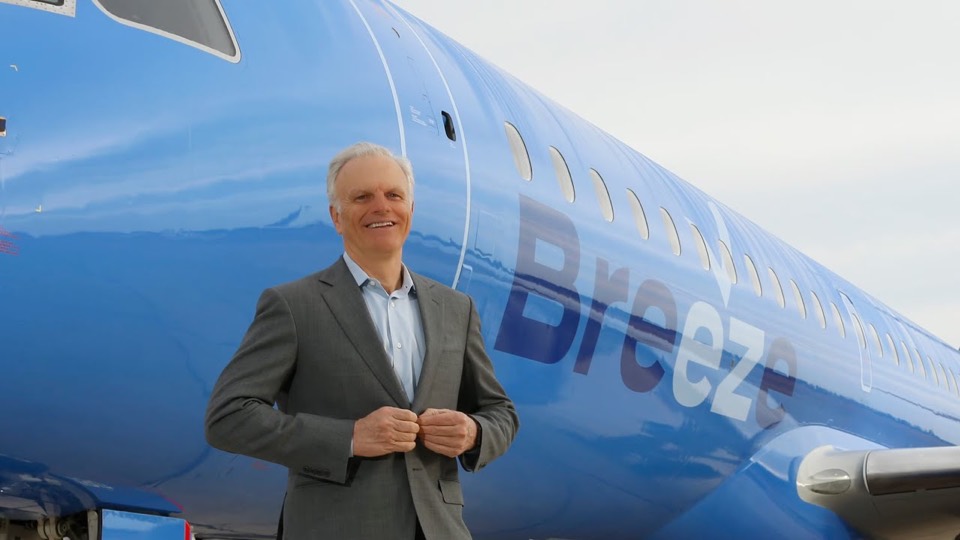
David Neeleman, CEO of Breeze Airways and 5X Airline Founder, sits down with Oyster Aero to share his journey. From launching Morris Air (later sold to Southwest) to creating WestJet, JetBlue, Azul, and Breeze Airways, David talks about what it takes to build successful airlines. We also dive into innovations at Breeze and discuss his friendship with the legendary Fred Smith.
Transcript
Read the full transcript
From the episode's captions, as published. Words that can't be made out are marked [unclear].
Welcome to the Oyster Aero PearlCast, where we sit down with founders and leaders shaping the aviation industry. From freshly formed startups to the biggest names in the sky, this episode is brought to you by our friends at Turbo Resources in Phoenix, Arizona. Now operating in 450,000 square ft of state-of-the-art warehouse space, Turbo continues to keep the aviation industry flying and is actively buying material. Hello everybody. Jeff Jerge, founder of Oyster Aero and uh the Oyster Aero PearlCast here. And we only interview founders of aviation companies and we did some soularching and probably one of the most serial entrepreneurs and successful founders is David Neeleman. So welcome David. Thank you. Thanks for having me. Absolutely. Um so I guess uh I count maybe seven eight ventures. I think you get credited with about five airlines, most recently Breeze, but there's been some other things. When did the aviation bug hit you? Like, was it when you were a kid or did it hit a little later in life?
Well, um, you know, my, uh, the PR department, um, at JetBlue found went to my parents and said, "Hey, have you got any pictures of David um, as a kid?" and they found one with a big with a big airplane on my cake when I was probably four years old. So, or maybe three years old. That's when it started when you had that airplane on your cake. Recently, you know, my dad passed away last August and right, one of my favorite things to do is to read his journals for my mom who's still with us and uh I read about my first airplane flight and I was born in Brazil. I was 10 months old and um we we we flew on a super constellation supercon from S. Paulo to Rio delayed to Brazilia to Manouse to uh Bogota to Panama City to Mexico City and finally ended landed into LAX.
So that was my first airplane flight. So it's a good thing I didn't remember that one. I probably would never got into aviation. So, I don't know. I just I was in in college and I don't know. I I just started getting obsessed with Southwest Airlines and I thought they were the most amazing thing ever. And so I just read everything I could get my hands on and started my own I had my own little travel company and that failed when Hawaii Express went out of business and I just ended up uh doing our own charters and and had had the dream actually of you know starting Morris patterned after Southwest Airlines. Uh so much so that Southwest came and bought us. So that was and then I got a chance to work with TURB for a short period of time. So that was, you know, that that's what got me into the business. Sure. Um, so when you started more, I mean, like I started a channel partner website, right? So it it's fun, but I can't imagine taking the decision to start an airline. I mean, when you look at all the approvals, the capital, you know, all the logistics and everything.
Was that daunting? Like did that scare you or did you just jump in say go for it? Well, at that time we were basically doing the easy way. We were just chartering airplanes, right? So I would call up and charter airplanes and we were doing schedule charters and we were doing operator produce contracts much like actually JSX is doing today kind of to to conform to the uh to the part 135 rules. So, we were doing that and then um Steve Hazy uh offered to lease us airplanes directly, airplanes that he had taken out of America West and he said, "You have to become legitimate. You can't keep doing this." Because there were complaints being filed against us with the DOT. And so, he referred us to just this great guy, Uso Schultz, and he was a had worked for the FAA, had been in World War II. He was an amazing person. And so it used to help us certify uh the airline and so we became a certified airline. Of course a lot of people objected like Alaska airlines other people uh to us becoming an airline but we got that approved and then we went for a short period of time after we were approved invented [unclear] travel. We were the first airline to ever do that and then Southwest Airlines came along and and uh purchased us uh in late 93 and I was at Southwest for about 6 months after they purchased us. So it it was a good experience.
Good. Good. So 6 months and then when you left now I met you and heard your story a little bit down in Daytona at Embry Riddle about 25 years ago. Um, I think you had a non-compete, so you said, "Hey, I can take operations to Canada." Is that kind of how it worked out? Yeah. Kind of a funny story about the non-compete. I haven't really repeated the story too much because I waited till her and uh and Jim Parker um went went on to greater glory. But uh Sure. after I signed the non-compete because Herb kind of led me to believe I was going to be at Southwest Airlines. And I I was there for like I said about 6 months, but I ruffled so many feathers. I I got there. I got them to put heads up display in the airplane because they weren't using all the equipment. I got um them to make Sunday a peak day instead of an off peak day, which is crazy when you think about it. Um I I integrated Morris into Southwest Airlines a lot quicker than than you know they had wanted to. Uh but um got got e ticket travel. We we basically got them exported all of our people down there and got them to be recognized in the Smithsonian as the first airline to ever have uh e ticket travel. Um so after then Herb said, "Great job. You did all this stuff, but you should have taken three years. You took six months and you've made everybody mad." So, um I about that time the justice department after after I Herb kind of let me go. I was asked to go speak to the Justice Department about um just the merger and all that. And so I went back there and Jim Parker, who at that time was the general counsel, he he accompanied me there. So he's he's sitting in the same room with the Justice Department and they said, "Okay, David, now you're out of, you know, Southwest Airlines, what are you going to do? Are you going to be back in the industry?" And I said, "Uh, someday, but right now I I can't because I have this non-compete." And they said, "Well, how long's your non-compete?" And I said,
"Five years." And they said, "Five years." And they looked over at Jim Parker and he kind of waved them off like this and said, "Oh, we know it's not enforceable." So, so I went mad and called her and I go, "What the heck, man? You know, it's so unfortunate." He goes, "Oh, yes it is. Jim didn't know what he's talking about and I will sue you. You're the last person I ever want to see in the other business." So, I just I I didn't want to cause trouble. So, I signed so said, "Yeah, that's when I went to WestJet and uh helped found WestJet with, you know, Mark Hill and Cla Betto and those guys." So, and Don Bell, Tim Morgan. So, uh yeah, that was I bited my time. And then also during that time my partner Dave Dave Evans and I founded what what be what became Navater and that's probably one of the biggest impacts on the low lowair business was Navater got 65 airline customers you know the company was purchased by uh Amadeas for close to a billion dollars. So that that was that's what I did during my non-compete period was started in Avatar. It was called Open Skies at the time. Yeah.
And um and then also um did did West. Well, that'll keep you busy. And then um let's see, when I met you, um you know, you had come down and kind of talked to us about this new airline, JetBlue. And a couple things I remember that really stood out is one, um Kennedy had nothing going on in the daytime, so that was part of the decision of going there. Yeah. live TV, leather seats, low fairs. So I think, you know, when you look back in history of the startups, when you start an airline, you know, the old model was buy some junky airplanes or charter some stuff and and just try to get passengers moving till you can upgrade things. And what I remember is your setout for JetBlue was to immediately upgrade the passenger experience at lower fair. So that was that was pretty cool actually. Yeah. So the industry was terrible at that time. I mean I what what you see today does not resemble what we had then.
I remember as far as competition. I mean it was you know it it it was absolutely terrible. Um and I had this experience that made me convince I need a leather seats where I was on a flight and I sat in some urine. Somebody had and then was the only seat left on the airplane. And they told me, "Sit in the urine for the flight. We'll give you a blanket to sit on or just get off the airplane." So I said, "I'm going with leather seats." Uh, and so um you know it it's John Owen who who was the treasure at Southwest Airlines and he had purchased and um more airplane probably more [unclear] airplanes than any airline any c any person in the history of of aviation at Southwest. So I sat down with him. I was there 6 months and even though it was a short period of time, I absor I I absorbed a lot of stuff and he kind of showed me put pen to pencil and showed me that it was actually cheaper to buy a new airplane than it was to have a used one. Sure.
And and that and engine overhauls didn't cost $11 million back then. So Right. It's even more more the case now. So um I said, "Why don't you come come work for us?" And he said, "Okay." So he I hired him to be our CFO and it was all new airplanes from the very beginning because we knew what they cost. We knew what you know he had the maintenance holiday and reliability and all that stuff. It it was just the way to go. So that was uh for that type of operation, high frequency, high utilization, you know, we had to have new airplanes. And I can remember being over at the at the Airbus factory and looking at this brand new airplane with leather seats and new new plane smell and the came a few months later. But it just blew away everybody really. And I think some of the struggles that JetBlue is having today and you know I was I was in the audience when one of the majors was giving a speech and and they said you know the reason we have live TV today the reason we have free Wi-Fi the reason we have leather seats is because that guy sitting down the audience. So, you know, there was a lot of copying that went on from what JetBlue had and and JetBlue, you know, a lot the products today are more similar to JetBlue and in case in some in a lot of cases because that first class now JetBlue is getting first class um is behind um has surpassed it and so um you know it's it's set it set a standard and that everybody followed for for the last 25 years.
interview the other day where Scott Kirby basically gave you a lot of credit for um you know coming out now um well Scott Kirby in that interview if it's he gives a lot of them but the one he said he was talking about spirit obviously in the ULCC's and he said uh contrasted them with JetBlue who started out with the notion that with with the customer in mind you wanted to create a great experience for the customer so yeah that absolutely the case. Um, you know, my my our motto was we were a customer service company that just happens to fly airplanes and that was our mantra from the very beginning. Sure. Um, another thing that's kind of struck me and maybe this is more of a founder thing than just like a traditional like MBA CEO thing. Um, you seem happiest when you're walking the aisles handing out snacks, throwing bags. It's not a photo op, you know what I mean? And it feels like when you're out with the users of the product, with the customers, it's it that struck me back then and I think I've seen that, you know, as you started other airlines and probably the ones before that, but I would imagine is that kind of a big part of your success is that you try to keep a handle on the very front lines.
Certainly has been um from the very beginning. You know, it's a little more difficult uh with Breeze because, you know, we're we're headquartered in Salt Lake. It was easy when I was at JetBlue because I lived in Connecticut. Our headquarters were 15 minutes from JFK. I could go out there anytime and throw bags and and they were actually they were actually JetBlue people. Everybody from the ground up were JetBlue. technicians, ramp guys, put a basketball hoop out there, played hoops with them, got in the belly of the airplane. That was easier. And um today uh we just announced our 78th city and we're spread from basically Pasco, Washington to to Fort Lauderdale to Banger, Maine to to San Diego. So, uh, we're all over the place and they're not, uh, they're valuable business partners of ours, but they're not they're not Breeze, uh, you know, employees and I could fly to Lancaster or wherever. Um, I could go up to Erie, Pennsylvania, and I would maybe see a crew going by. So, what I've used technology to make a difference in that.
So, yep. How I do the touch points now is I have a weekly call with our pilots every single Tuesday at noon. I have there's a weekly call with our flight attendants, which I participate in um from time to time. I have a um a every other week call with our technicians, which I'm always uh participating with. I have a uh a every other week catch all team member call. Had one yesterday. So, if you add up all the people that participate, we have about 200 people um either live or recording, we touch about 1500 to 1,800 people uh every week. And so that's how um and then get them in the huddle, talk about our business, talk about the industry, talk about what we need to do better, talk about um all of our successes, um and of course what we need to do better. So talk about how we want to be on the road to perfection even though we'll never get there. Uh we get better along the way. So those are really important messages that um but but technology has enabled me to to kind of virtually be there with everybody all the time.
Sure. So you're still Connecticut or East Coast based and then this airline is out of Salt Lake obviously. So no I I'm actually in Salt Lake. I'm in live in Deer Valley. So you know I live in Utah. Got it. Um, so I guess I want to talk about Breeze a little bit, but I have one more question around the airlines. Is kind of each airline the same playbook? Like would you say Azul and WestJet and JetBlue is kind of like, you know, the same model or are there different intricacies that you have to consider for each one? I mean, there's elements, right? There's elements that are similar. Um, but I learn along the way. And one of the what what's really important and this is top of the pyramid is that you have to you have to have the there has to be an opportunity. Yep. Uh you know I I don't it's too hard to start a [unclear] anyways. Uh to do it just for the sake of doing it and say you did it is not not in my rule book. There has to be a you know [unclear]. Um, and you know, one of the reasons I sold Morris is that we were sitting in Delta's hub and we were, you know, I had was looking at the revenue one day and kind of an old waror um came in and looked at these things and he said, "You're so susceptible because all all Delta has to do is match your fairs and it'll be revenue positive for them and you'll be out of business." So, I sold to Southwest because of that.
Um, so then you know, JetBlue was Kennedy was wide open and it was really tough to not and we had a better product than everybody else. U so we I always have this thing that too much overkill is never enough. It's not just enough to be in Canada. You need to be the best product. You need to have the best customer service and you have to stack those things on top of each other. um Azul uh WestJet um Western Pacific had just gone out of business and it was just it was basically Air Canada and the whole whole dang country and and they weren't strong in the west so replacing them. Uh JetBlue we talked about JFK was available Azul um you know you basically had two airlines doing the exact same thing. Y there were literally hundred cities that weren't being served when we got there that we're serving today. a hundred different cities and and their kind of inability or or unwillingness to kind of move off of one aircraft type. They just said, "We're going to do this uh with with one aircraft type." And we said, "Great. We'll go do the rest of the 100 cities and we'll get caravans, we'll get ATRs, we'll get uh embryo 195s, and then we'll move up the scale and get the 321s and the 330s." So, and then and then Breeze uh you know there were 125 communities that lost more than 25% of their air service. Um as the cost had gone up and up and up in the US u there had been a retrenchment to the hubs and then coupled that with pilot salary increases that made 50 seaters obsolete pretty much um and and regional jets very expensive to operate. And so there was a kind of a room for a like a 137 seat uh opportunity, but it wasn't just a 137 and and it we don't have TVs because I don't think TVs are that important anymore.
I think it's kind of interesting that Delta and United do. Um but Wi-Fi is important. Really, really important. So we went with the high-speed Wi-Fi integrated into our bundles. uh and and then we have a a size of airplane with a luxury with a high-end product and you know I as I think back on it um my experience the the airplane was very conducive to first class you know had we not bought that airplane I don't think we would have gone with first class but the fact is you lose about 50% of the seats in the first class section and you can charge twice as much so it's just math That makes a lot of sense. And we can go from 12 to 16 to 24 seats. And we know we started out with more, we have less, now we're going to go to more. So, you know, that those are options that we have. And we can do that on overnight, basically. Um, but we we said, okay, we want to fit this niche somewhere between 174 seats and 160 to 180 seats. We want to be at 137. We want to have 45 extra leg room seats. We want to have 12 to 16 uh to 20 to 24 um uh first class seats and then we want to fly between cities that don't have non-stop service and that's about 87% of the time we can do that and it's it's which is very sustainable.
That's wonderful. So cost right cost you say well what about your seat costs? So the the ULCC thought well let's let's go jam 240 seats in a 321 only get 321s and you know nobody can compete with us on [unclear] costs. Mhm. Well all United and those guys had to do is go bigger take the incremental seats and they had for the 20 or 30 extra seats they had on going from a 320 to 321 they had them for a lower price than what the ULCC's had it for. So all they had to do is match them on those seats with frequency with [unclear] flyer and all the stuff that they have. Um and you know it was kind of no no question who people would choose. Wow. And then uh the fleet obviously in Brer and A220. So um the A220 should serve well, right? Yeah. I mean the the 220s um got the engine issues. So um you know we're very innovative. We went and uh we picked up eight Egypt airplanes that um as you know as part of the deal and we we have them kind of scattered around our system. We use the engines.
We're not going to worry. We don't have a single airplane that's uh parked because we have spares between what we own and what we will finally be getting on all the [unclear]. We have 26 spare engines for a fleet of 40 airplanes. So, um, you kind of need all that just to keep from, uh, having planes be parked. Very cool. Um, I'm in the supply chain side and I've always heard that like maintenance is kind of like the third cost in an airline. You've got crew and fuel. So, where is that kind of still true these days or is that uh kind of fluctuate depending on what kind of model you have? Well, for the first time u maintenance has surpassed the ownership of the airplane. So, right. So yeah, it's moved into number two uh three. So we have to figure out how to do it differently. Yeah. Um and we have to um you know, we we uh you know, one of the things we do down in Brazil is we have two PC12s and the PC12s kind of fly during the night and day and they're delivering crews and technicians and parts throughout the country. So, we're going to mimic something similar at Breeze to make sure we have aircraft availability to minimize the number of operational spares. We have two operational spares today, plus we have the EJF fleet. Thank goodness we have that very reliable, great airplane. Uh those will be phased out by the end of next year. Um but we have time to kind of build a redundant operation um with recovery options. And you know, we're working really closely.
You know, there are there are parts on this airplane that um that don't go um as long as they should go, right? They need to be re-engineered. So, there's about 10 parts and that need need to that should be on wing for 2,000 hours or 4,000 hours and you know they're at they're 800. So, you know, and so I think AI and predictive maintenance we've always done, but I think AI is going to play a lot greater role. We have so much data that comes from the airplane every day. You know, we are really focused on downloading all that data and and preemptively um fixing things or replacing things um before based on um history. And it's easy to do it kind of on a very top level, but um I think we can get a lot more in depth and a lot more um and more a lot more effective.
Very cool. Yeah, that was one of the questions about AI. So um Breeze is now about four years old, I think, and you guys just announced some westbound. Do you have a favorite city like that you've uh or a region that you've launched into recently, or are they just all kind of near and dear? They're all good. Yeah. You know, it's and the maturity curve is is real because when you start in a market, nobody knows who you are. Y you don't have any repeat business. And as you build that business, as you um you know, Ryan Air, I love the story of Ryan Air of I'm trying to think of the name, the secondary city from Tuloo. Um we were just down there. My wife was out there visiting while I was at at Airbus. So they start flying down there and everyone's like, "Why? who why why wouldn't go to there in in France and all these British people flew down there and they were looking at these French country cottages and saying, "Holy crap, I can own a French country cottage for 60,000 quid or whatever." And so they went down and snarfed them all up and they created a business where people can go back and forth to their French country cottages. So, you know, I think I've always thought there's a realist, you know, certainly we first need to do cruises and packages and we haven't gotten into that yet as much as we should have. Now, we're going to get our international approvals here hopefully pretty soon. And once we do that, we're going to get more into packaging business. But then, you know, maybe there's some a real estate play as well where we can market real estate to some of the routes we I serve 11 cities in Florida. It's crazy. And so, um, and Florida real estate's kind of down now.
So, you may tie those two together just like the Ryan Air did. Yeah. I mean, in the 80s, I remember airlines kind of branched out into resorts and stuff like that. So, maybe maybe that can have a comeback now. So, yeah. I mean, it's not like we're not going to go spend 800 million on a resort that we sell for 200 million like alleged, but you know, at least we can promote what's out there. Very cool. Um I guess um the other thing that has kind of um I wondered about and you know, you've talked about having ADHD and being, you know, a little quirky. I think that's a trait that helps you see things maybe that other people don't see. Um, is that kind of um, you know, do what's your perspective on that now after seven, eight companies? It's it's a two-edged sword, right? Um, you need to surround yourself with people that compliment what you do, what what you're good at. So, yeah, I I think I have an ability to see around corners. U, but then, um, you also have people to say, well, wait a second. You know, there there's thing about my my brand of ADD that I think frustrates people sometimes. is that I I I simplify everything.
I'll take a very complex issue and I'll say, "Why is this so complex? Why don't we just do this, this, and this?" And they'll say, "It's not that not that simple." I go, "Prove it to me." So, it's all about, for me, it's all about facts and data. Bring me the data. Show me we can't do it. And if we can do it, now obviously safety is top of the pyramid. And sure, you know, I'm I'm a I'm I'm a radical safety guy. Um, that's my area of hyperfocus. But beneath that, it's kind of like how can we do this more efficiently? How do we do this better? How do we um why do we why is the industry always always done it this way? And you know um I I know in Europe people have chase planes that go behind their planes with parts and technicians. Why don't we do it here? You know, so um we've proven and we had one airplane, one of our PC12s in in May. It's the last time I looked at the numbers. Uh, one was in the shop and one was available and it had 61 flights in one month and counter rescue operations. So, you know, planes are reliable but still they break up they have 90 98 and a half dispatch reliability. And when you have 250 flights a day, which which we're kind of getting up to like 227, you're going to have a you're going to have a broken airplane every day somewhere. So, it's just the way the numbers work.
All right. Um, two last questions for you. I live in Memphis and hopefully you can see my screen there. Um, last month we lost Fred Smith and um, you know, I guess I was just curious uh, what was he like? I never met him obviously. Um, just in is there anything from him that's kind of shaped you over the years? Oh man, what a treasure that guy was. I um he was you know when I was a young um young CEO at Jablau he was on the at the time it was the ATA now A4A board and when he'd walk in the room and he would sit down and open his mouth we were just like I I would just sit at his feet and listen and nobody I mean everybody knew he he swang a big bat in Washington and nobody questioned what anything he said. He was so in tune with everything in Washington. Um then fast forward um for the past 10 years I've owned a home uh in the neighborhood where he has a home uh here in Utah and we became very close. Um you know, I just I get choked up when I think about him. He was every single time he would come to town, he would call me up and say, "Hey, I'm in town.
let's come on up and let's chat. And uh we had so many memorable times together. Um you know, kind of the last time um one of the last times I was with him um that where that picture was taken, I was speaking at a Goldman Sachs conference and he was and I looked on the agenda and he was speaking and I called him up. I said I said, "You're speaking right before me at this at this conference in Napa." And he said, and I was had booked a flight, my wife and I, we're going to fly to San Francisco and get a car and go two hours north. And he said, 'I'm pick you up. And I said, what do you mean? He said, I'm stop by your house, pick you up, and we're going to fly out of He um and go right into Santa Rosa. And uh so we had that flight. And that was where that picture was taken. But that and it's just as he would talk about his experience in Vietnam and he talk about u speeches he you know he gave and the just the policy the you know he he spent an hour in in with with President Trump um you know a couple months before he died he everybody called on Fred Smith.
He was a treasure, a national treasure. And when I found out he died, I was so sad. I mean, I was just like I I just it's like I would never hear him call me and say, "Um, hey, come on up. I'm in town." And bring that sweet wife of yours. You know, he always loved my wife to come up to. So, u Yeah, meet his children, you know, wife. Just h just what a great man. I I miss him so much. Yeah. He seemed like a really really phenomenal individual and obviously successful but then in his personal life. And then um speaking about personal life, I mean in the middle of all these companies and aviation things you've done over the years, you've got a couple of kids and grandkids, I'd imagine. [laughter] I do. I've got I've just uh my 36 grandkid will be born any day now. So yeah. Oh wow. My kids are doing doing the job and making it happen. You know, Fred had 10 kids and and so, you know, we we always talked about that together. It was, you know, family was certainly top for him.
You know, I had heard when he passed away, he spent the whole day with his family in the family compound by the pool. Then he had some some kind of tightness in the chest and and uh said, "I'll be right back, guys. I just got to run to the hospital." And then he he died on the way to the hospital. So, that was his last thing that he spent time with his family. I mean, that's what that's the way I want to go as well. So, yeah. Do you have time for that these days? I mean, are you able to kind of balance things pretty good? Oh, absolutely. I always have some time for my kids and my grandkids and um in this house we have we have um we ski and ski out and I buy 26 season passes every year for all my grandkids and they're here all winter skiing. Oh, nice. Nice. Summers they come here. So, yeah. No, we have lots and lots of time together. Good deal. Yeah. I um we have a lake down below and and we have a boat there and they spend summers on the boat and winters skiing. That's neat. I will say probably one of the most rewarding things about not being in corporate is um you know my oldest is getting ready to go to UT Knox and for the first time and so we're spending the last couple weeks just hanging out with him and you know get the time to do it. So it's a lot of fun.
So yeah, that's awesome. All right, David. Um, thank you so much for coming on. I hope you've enjoyed this. It's a little different format than probably a lot of the other podcasts that you've done, but I really, really appreciate the opportunity for you to hang out with us for a little bit. Thank you. I appreciated talking to you and uh, best of luck on your business. All right. Thanks a lot. Thank you. Bye. Bye.