PearlCast › Episode 27
Episode 27Mar 16, 202619 min
John Cuomo, VSE
About this episode
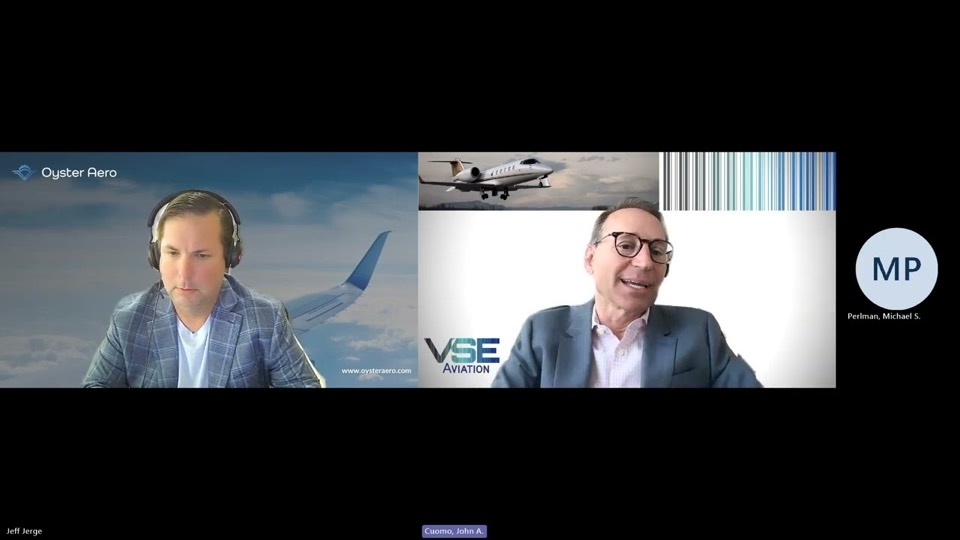
We are honored to have John Cuomo join us on the latest episode. John shares the journey of his career starting in Law, to building up KLX and the current impressive transformation of VSE Corp. Among many topics, John shares the importance of aligning culture in a multinational public company.
Transcript
Read the full transcript
From the episode's captions, as published. Words that can't be made out are marked [unclear].
Welcome to the Oyster Aero PearlCast, where we sit down with founders and leaders shaping the aviation industry. From freshly formed startups to the biggest names in the sky, this episode is brought to you by our friends at Turbo Resources in Phoenix, Arizona. Now operating in 450,000 square ft of state-of-the-art warehouse space, Turbo continues to keep the aviation industry flying and is actively buying material. Now, we hope you enjoy this episode. All right, hello everyone. Jeff Jerge with the Oyster Aero PearlCast and honored today to have John Cuomo, CEO of VSE. How are you doing today, John? Great. My voice is a little shaky, but uh doing okay, thanks. All right. So, um I guess we always start these with um you and your career.
When did you get the aviation bug? How did you get into the industry? Uh yeah, I mean, I didn't start my career thinking I'd spend kind of decades in aviation like I have. You know, I actually began as a lawyer working on commercial transactions, but early on I had the opportunity to work with a small aviation business. And what struck me instantly was how the there's there's a mission around it. You know, being in a law firm, when you work for a client, you kind of finish a project and you move on. And what I noticed about this client was, you know, there's this global mission critical aviation kind of ecosystem. And once you see how everything from supply chain logistics to repair to, you know, keeping, you know, airplanes safe and in the air, it's hard not to get uh get hooked. Wow. Okay. Um, so when you dove in, I guess it's interesting. How did your law background helped you, do you think? Like what what what's applied there?
Yeah, I mean, it's interesting. I mean, just like 90 seconds on my background. So, I got into I I worked for a small distribution business, helped sell it uh to Beat Aerospace, which was a public company that was building out um you know, they were the largest seating manufacturer at the time, and they were building out a distribution platform. So, this was going to be the kind of the core anchor or foundation for that distribution platform. So a few things I mean number one is you know the two businesses that I've been part of be aerospace and you know became KLX when we did a spin-off and now VSE they're both public companies that have had a lot of M&A and you know acquisitions as part of their strategy. So there's been a a lot of core experiences that I've had in my legal background that supported me. The other thing I would say is just issue spotting. I mean, what you learn as a lawyer, at least hopefully as a good lawyer, is when you weed through everything that's out there, what really matters. And in a aviation where every part has a story, learning kind of those detailed issues and what really matters behind kind of a total solution, I would say is probably the biggest takeaway that I had.
Yeah, I've heard that a law education is phenomenal because if nothing else, it teaches you how to, you know, think critically and and and I would imagine that that's helped quite well. So um I met you and Ben at at Boeing after the KLX acquisition. So um so so how did that grow story from briefly from be to KLX and selling to Boeing? What did you focus on back then at KLX? Was it OEM expansion mainly? Like what was the growth story there? Yeah, I mean that was an 18-year story of taking a $35 million revenue business to two billion. Um and it was really about um consolidating a market uh you know a global market for consumables and expendables. Back then there were really local suppliers for hardware and chemicals and the like. And when you looked at your large OEM partners, you know, think of an RTX, you know, at the time you had, you know, Goodrich and UTC and such. And they were building out global platforms of where they needed to support their OEM production um around the globe and then also to support their aftermarket customers. we kind of followed them and started to build a global platform of 50 locations for us to be able to support them. Um, you know, that business was one that we sold to Boeing on one ERP system, kind of one organizational structure. Um, and it was really designed, you know, as Boeing was building out their global services as as uh, you know, kind of what we believe was the largest but more importantly the best uh, platform in that capability set in the market.
Got it. Okay. And then um so you you started inv there. What what what was what was the organization structure? What was the the product focus? What was the company that you felt that you were walking into basically? Yeah. I mean I knew it was something different for me and I was ready for something new, a different challenge. Um it was a three segment business. It was a defense business that was predominantly non-erospace. Um what they call the fleet segment which is really automotive distribution and then a about $125 million uh aviation aftermarket business with uh kind of three assets that were not integrated. So it was a very fragmented kind of industrials type business. uh you know kind of too small to be as fragmented as it was candidly and as anything else you kind of go in eyes wide open but you know 80% or less is what you thought it was and the rest is the you know you got to figure it out along the way.
Sure. So you you obviously landed there and um what's some of the first couple of things that you did while you were evaluating? Was it was it people? Was it like like was it culture? was like what what what did you start with? Yeah, I started with with the value proposition. You know, who are we going to be? Who are we today to our end user customers and to our suppliers and then who are we going to be tomorrow? You know, at the end of the day, when you live in these services business, you've got the OEM who makes something, the end user who uses something, and when you live in between, you know, you you really have to determine how are you adding quality value in that supply chain. So for each of those three business segments, I kind of determined who are we today, who should we be tomorrow? And it's like throwing darts at a dart board. How many of them actually are sticking in the in the bullseye. What I saw very quickly was the OEM ccentric model that I was building around aviation which was quite different uh than an than than what existed in the market you know um when I got there which is you take our large OEMs and it's you know let's say 150 or $200 billion aftermarket you know how can you partner with them first and the end user second so you're looking at your large OEM and saying how do I help you monetize that aftermarket protect your intellectual property support these 20,000 end users in a unique way that really was sticking. Um, but then in my defense business where I didn't have a lot of capabilities. Um, I would say the value proposition didn't stick as well.
And in my automotive business, it it was it was working out okay, but it was just so disconnected from what I was doing in in the other two segments that, you know, I had to really sit back and pause and say, you know, can I run this business this diversified or I do or do I need to make a change? So that's when it went from value proposition to your next your other comments which is culture people and we had to make some tough decisions on devesting non-core assets kind of re-evaluating the culture in the business and really looking at the orc structure and then who fit in those seats. So it was a true kind of a four-year I would say transformation process um you know that had that had an endeavor and you had co in the middle of it which was you know the ultimate fun. Yeah, I think you started a trend. I read an aviation week article yesterday that said that the diversification used to be the play and now when you look at, you know, like the GES of the world, the Honeywells of the world like like like focus and shifting to deep portfolio is is sort of the trend there. So that's uh that that that's uh pretty cool. So um all right, you get there, you've divested some companies and now it's time to grow. I mean I I don't remember the exact numbers but you went from three 400 million and now you've gone into the billion. So how's that what what's been the growth uh strategy there?
Yeah I mean from an av you know again we devested of a ton of non-core things. We essentially took an $150 million aviation business and you know you'll look at 2020 um you know let's look at 2025 kind of round numbers at 1.1 billion and you we took market cap from a public company from about 350 million to about you know a little over 6 billion. So it's been an unbelievable and exciting journey. you know, it really at the end of the day starts with one customer at a time, one product at a time, and one kind of OEM, you know, program at a time. And that's really how we focus the business. So, back to that comment you made about um, you know, being narrow and focused, you know, at the end of this year, you know, as we look at 2026, we'll probably have, wow, probably 45 or so MRO facilities. And you know each of them with a few exceptions where we're doing a few things at you know the same things at each side each of them will represent a very distinct kind of center of excellence and center of excellence focus and really that's how we built the building a business. It's off of uh you know kind of a center of excellence focus and a customer by customer strategy. Um, obviously there's been a lot of organic wins in there and then a number of acquisitions that we've uh combined businesses and created kind of a a greater VSE family over time.
Sure. Yeah. Uh, the Celstrom acquisition was was was interesting and then most recently um, Precision Precision Aviation Group. So, um, what's the what's the latest on that? Yeah, that I mean that the acquisition hopefully will close, you know, in the second quarter. Um really this is kind of you know as we look at kind of what's happened after the uh the platform kind of optimization and moving to a full aviation focused business in 2025 when you look at what really can scale the business you know you have to discipline is like a key uh term I use all the time although we're growing at a very fast pace we're doing so in a very disciplined approach and when you look at kind of what is that transformational acquisition where 1 plus 1 is going to equal far greater than two. Um, this is the deal for us. I mean, it's it's greater than 50% revenue growth. It's accretive from a margin perspective. The cultural alignment is is tremendous. Um, it puts us in a position where we'll have one of the broadest and deepest MRO networks in terms of capability sets in the market. We've got a a really expansive and diverse group of customers from every commercial airline and MRO to you know the the long tale of business and general aviation and rotocraft customers. Um about 50% engine and 50% non-engine from a capability set. So really exciting to kind of look at this capability set of what we're building and it'll create a really new VSE as we kind of exit 2026.
Well, excellent. And then um the engine market certainly is growing too as well for for VSE. Correct. Yeah. I mean you know it's just a natural um I'd say of all of the markets it's naturally growing at the highest growth rate but for us we've been you know we've been expanding organically and inorganically um you know to accelerate that growth. So, you know, our engine business, you know, over the last 3 years has grown probably in the neighborhood of 20% and we do expect it to continue to be a double digit growth driver for us uh in the near term as well. Got it. All right. So, I guess um capping off on VSE, what does the next couple of years look like as far as strategy that you can share? Um and then also maybe if you could highlight some things in the industry that are shifting that we should be watching from your perspective. Yeah, I mean I'll start with industry stuff and macro stuff first and then kind of drill down into VSE. You know, I think as you look at kind of the the macro factors uh you know there's still a lot going on. You know, you've got aging fleet, you have uh global air traffic growth um continuing to expand, you have supply chain complexity, you know, not ending because it's the same market and now you've got, you know, increased space, increased defense work. some of the you know um other types of markets that are attacking the same supply chain you have a continued focus on kind of outsourcing of maintenance and logistics you know but all in all you know I think when you look at the aviation aftermarket it's a very structural attractive market you know aircraft fleets around the world are a aging with travel demand continuing to grow airlines increasing rely on specialized partners like VSE but there's obviously it's great for the entire market to maintain and support those aging assets. And aging assets are retiring at a lower rate than historical levels. Um, and I think what you're going to see is just a growing market in
totality, but you're going to see the aging aircraft, people wanting to extend the life of those aircraft while next generation aircraft are going to start comecom coming due for maintenance and us figuring out ways to support th those aircraft. So if you look out kind of 3 to 5 years, you're still going to see strong no you know at the conservative end kind of mid single digits but at a more aggressive end kind of high singledigit macro aftermarket trends which obviously is extremely attractive uh market to be in considering that the markets have kind of grown consistently since co. So, you know, what that means is it's it's determining exactly back to that kind of micro level where are the specific buckets that um that are that that capacity is needed and how do we go fill that capacity whether it's with labor, whether it's repair capabilities, whether it's with supply chain and products. So I think that for us at VSE um where we can where we are kind of proactively investing is you know where do we see the physical capacity in terms of repair capabilities that I've got to go build out and more of that's on the engine side than not. Um where is that technical talent that we have to either go help educate or continue to groom internally to be able to support that demand. Um, you know, and then, you know, how do we continue to connect with our end-user customers and our OEM partners that what's in my mind and where I think the market's going is exactly where they need me to play so that could I could be that nimble and agile player to move on a dime to support them. I think at a micro level as you look at VSE I think it's really actually going to start with culture and then kind of uh probably end with execution for us as we bring these businesses together kind of under one VSE umbrella you know you the expansive nature of the business as we move into uh 2026 we'll have you know north of 2600 employees about 60 locations
globally it really comes down to um a real big kind of [unclear] I I was telling my head of HR the other day I think it's time for a strategic pause where we sit back and look at you know where we are with the cultural evolution of VSE how we continue to make culture intentional in this global organization what's the common language we're going to have what are the common values how are we going to speak um around those common values you know I'll give you an example like we have a value that we call speak up which is really about at the end of the day how do You get people at all levels of the organization to feel comfortable and confident sharing with you what they see because at the end of the day, you know, the the answer is far more on the shop floor than it is in any kind of seauite or conference room, you know, so how do I take those 60 locations globally and get those teams to feel comfortable around it? So yes, it's the common language, but it's also around, you know, recognizing um and you speaking that language, rewarding people around that language. So I think for us at VSE, it's you know, first it's bringing all these businesses together under that common culture. Second, it's making sure that everybody at every level of the organization feels valued and feel like they can speak up. And then third, it's how do you convert that that strong culture into execution? that's second to none around the industry where our turn times are better than anybody else. Our on-time delivery is better than anybody else. That we understand products on a part-by-part basis and our every part has a story is stronger than everybody else. And then we could and at the end of the day, you're converting when a customer or supplier calls you with a quote unquote problem. You're just not just thinking about a generic solution, but you can dive into that detailed solutionoriented focus. That's really what's going to I think drive the next phase of growth and excellence for you
know VSE in connecting with that macro problem uh statement that's out there in the industry. Sure. I mean that's a tall order to get that all under control but given your background and your team's background you've already done it. So I'm sure uh you'll continue to lead the way for us and it's been fun to watch you all grow tremendously over the last several years. I'm sure Ben is keeping busy. um you know uh with with all the acquisitions and integrations and everything. So that's that's got to be fun. So yeah, I think that's that's an understatement. You know, it's uh you know, he's he's got you know, we managed to micro P&Ls. So he's got all the P&Ls under him, you know, and how he leads. So again, you know, having some organizational design sessions and making sure we're keeping the business nimble and agile and as you grow that what made you special as a small business in how quick you can respond. Um that that DNA and that energy doesn't leave. That's the stuff that you know keeps me up at night and that's the stuff that you got to keep keep the focus on because that that's what makes things special.
Yeah. Yeah. That's the magic being able to be serviceoriented as you continue to grow. So, well, John, really appreciate you coming on. Honored to have you and it'll be fun to continue to watch you. And I'm assuming we'll see you down in Orlando, maybe at MRO next month. So, absolutely, Jeff. Thank you. Thanks for having me. All right. Take care. Thanks.