PearlCast › Episode 26
Episode 26Jan 28, 202624 min
Wayne Mihailov, Airline MRO Parts (AMP)
About this episode
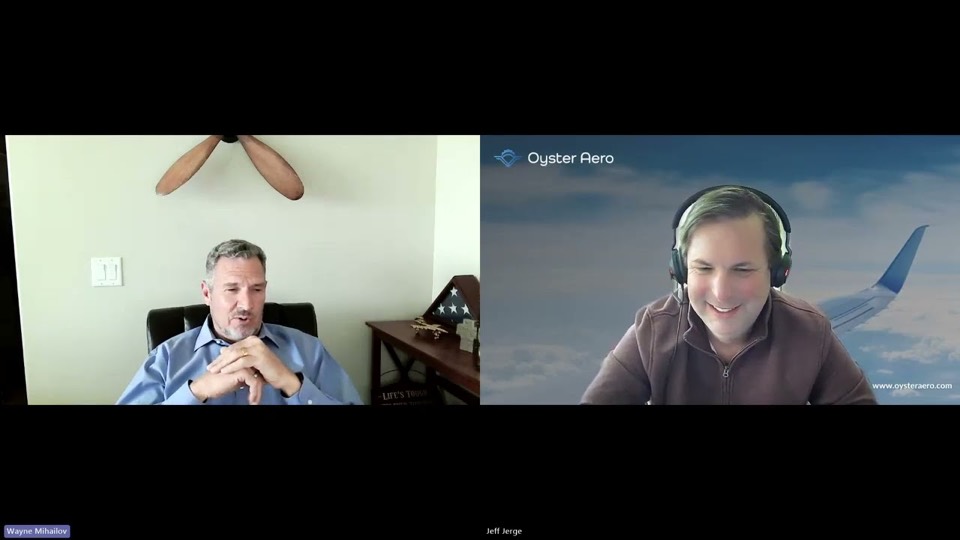
Check out this episode with industry legend Wayne Mihailov, founder of Airline MRO Parts (AMP). Wayne walks us through his time at the Naval Academy, landing at GECAS, and through the eventual founding of AMP. Company culture, customer first ethos, automation, safety, and speed. It's all here!
Transcript
Read the full transcript
From the episode's captions, as published. Words that can't be made out are marked [unclear].
Welcome to the Oyster Aero PearlCast, where we sit down with founders and leaders shaping the aviation industry. From freshly formed startups to the biggest names in the sky, this episode is brought to you by our friends at Turbo Resources in Phoenix, Arizona. Now operating in 450,000 square ft of state-of-the-art warehouse space, Turbo continues to keep the aviation industry flying and is actively buying material. Now, we hope you enjoy this episode. Hello everyone, Jeff Jerge with the Oyster Aero PearlCast. I am so excited today to have Wayne Mihailov with Airline MRO Parts, informally known as AMP. And we also are joined by Abby Sparks with AMP as well. Thank you so much for putting this together. I know you're going to drop off, but just wanted to say hello. How long have you been with AMP for, Abby?
Um, I started here with AMP in 2025, about midy year. Um, I came uh from another uh large large company in the aerospace industry and have just been delighted and encouraged by um the entrepreneurial spirit of Wayne um and just the the forward thinking um at AMP. So um I'm excited for you get to have this conversation with Wayne and hear a little bit about um the backbone and the why behind AMP and all the great work um that is being done here. Great. Thanks a lot. We're looking forward to it. Take care. Thanks for joining, Abby. Now I can use smaller words. I can use big words around Abby. She doesn't do small [laughter] words. Enjoy. All right. Bye. All right, Wayne. So, um, thank you again for joining us. So, um I guess I kind of always do these with founders as you know and um I'm intrigued like I kind of want to go through your background a little bit before maybe starting AMP. So, uh Naval Academy Naval Academy graduate of the great class of 1993. Married a Naval Academy grad. Actually, not my classmate, but married Naval Academy grad. Uh was a civil engineer corps officer. uh wanted to be a pilot but at uh 68250 my physiology didn't agree with my childhood dreams. Uh so uh civil engineer corps uh really enjoyed that career. uh got a couple master's degrees on the side and um and then got into GE GCAS where I spent eight years uh with a roable optimization product there a leasing product uh was originally on aircraft engines then moved over to GCS uh was part of the the team that meshed in we acquired the Memphis group uh where you you had some uh experience as well with some great leaders like Kathy Williams, John Williams and Sean Flannry who's near and dear to both of our hearts. Sure. Yeah. Got out of GE and to do my own company.
Uh did some sales and marketing consulting, some M&A consulting. Uh helped uh a company you mentioned earlier. Uh actually do a big acquisition that grew their global platform. Um got into the expendable space. Uh really looking at the residual values of investing in expendable space. Uh built my own evaluators around that. Partnered with a lot of the surplus traders that you partner with as well. Um and then ran across this opportunity. Wow. Okay, that's uh that's good. So, you're doing some consulting and then did you buy the company or did you start the company? Started from zero. Okay. All right. So, tell me like what was the problem that you were trying to solve and and what you know what what got you up to go do that basically? Yeah, that's a great question. I love the way you framed that Jeff because that's that's right. It's it's all about solving a problem or an opportunity and you know originally uh um you know this business was started focused a little bit more on the surplus side. Um but I was uh you know asked by some private equity partners to look at supply chains a couple of their businesses and it always shocked me with supply chain and this is a stupid thing that I that I say too often but I look at our industry and talking about just commercial aviation to me Jeff it's amazing the safety and reliability with which our industry operates on the front end today we'll move over two million people in the us alone.
Right. And and if our industry is so safe that if a door flies off an airplane where nobody's killed, it's headline news for two years. Right. Right. I mean, we talk about our delays or whatever, but the reality is the on-time reliability is amazing. The technical reliability is amazing. It's an incredible industry. And then you go look at the back end and u you feel like you're the Back to the Future movie. Sure. Still people with faxes. Okay, there's still there's still there there's still processes that that involve, you know, look like a spaghetti uh a plate of spaghetti. And so that's what we really looked at and it was a great opportunity for me and and in in advising on a supply chain and and what I thought of how it worked and I said it doesn't work very well. It's it's kind of prehistoric. Um and and and the reason that they've stayed that way is because it's kind of the if it ain't broke, don't fix it. you know we we're operating safely and reliably like don't change it. Um but the truth is you can enhance both safety and reliability with better enterprises there as well. Um most organizations Jeff as you know I mean I look back 10 years ago most were not even take advantages of proven platforms like a exchange right that's where we actually built all of our automation technology was on that there's a great connectivity platform and nobody was very few people were even taking advantage of that outside of some of the major airlines. Um so we just I just really looked at that and and built up you know not only a problem statement but a business plan to say here's how we could make that better. Um if you look at just the MR so material requisition or material request to purchase order most organizations if you look at like a heavy maintenance organization most of them take two to three days in a manual process from the time they have the MR which there's often the upstream of that as well parts application MR but two the PO actually being placed or or if you really want to think of bigger and think across organizations being accepted by a supplier it's two to three days right we all know that an aircraft sitt on the ground cost you about 50 grand a day, maybe more.
Does that make sense? And so that was the opportunity that we set out to solve. Very cool. And so, yeah, it's it's even worse when you have an AOG over an expendable, right? I mean, sure. For sure. And and and it's interesting that, you know, the term AOG gets used in the heavy maintenance world. Uh but all the aircraft are on the ground when you work on them. But but they but and every part is critical, right? The airlines uh you know I joke around and say that you know it's you know airlines are really picky. They want 100.0% of the parts on their plane when they pick it up. And so so in a way every part's AOG and it's huge volumes of expendables. To your point, it's the exact certain bolt. It it's it's a you know $17 bolt but you have to have it. Sure. Yep. And so getting automation, getting the bulk through, getting the 95% ordered instantaneously so that you can really have your team focus on the last 5% and address that that tail and make sure that aircraft gets out on time was a huge opportunity.
Okay. So it sounds like you were really um I mean very customer focused and just trying to solve that time problem with the business whereas some people are like oh I'm just going to get in the first part business and you know just it sounds like you were trying to be uh kind of unique in that. So um once you got going you know that there I know I have my own uh heroine stories with Oyster and getting that off the ground. Um, what uh what what is there an event that you're willing to share that you look back on and and kind of laugh now, but at the time you're like, I don't know if that's going to work, you know, [laughter] anything like that? I would say more of that. That's a great question. Um I don't know if I have any very specific you know like kind of run out and go drinking story or something but I definitely other than co um but uh for in terms of just getting the business started it's just the basic nature of complex solution selling as you've done in the past and with your with your history Jeff uh it getting organizations to change is just hard and when you start talking about a complex solution that's going to hit multiple departments in an organization at multiple levels I mean when We go in and we look at we we showcase our automation to a seuite of say a heavy maintenance MRO those those folks get it immediately it's it's it's not a problem and so you think but okay the sales made because the CEO the CFO the COO they're all like start tomorrow the problem is you have 14 other layers of people across multiple departments and there's certain people out there that if if you know they they don't see that value instantaneously they're focused maybe on the direct part cost okay well I can find a part for 50 cents cheaper over here. So, it's $17 instead of [unclear]. It's like, yeah, but it would have taken you a week to get it. Um, and so they just they've missed that. And so, trying to get past all those types of objections and getting you have to have 90 plus% of the people on board if you do a full stakeholder analysis to get that complex solution cell. So, that can wear on you because it, you know, the sales cycle for something like this, uh, to really get up to the
majority of wallet share um, you know, is 18 months. And so you have to have the persist. And so I would say it's one event, but it's definitely, you know, a little bit of death by a thousand paper cuts. So there's times when, you know, after a year of pounding and and trying to help somebody out, help them make their life better, and you're still not getting the flows that you're looking for, it can be uh it can be a little frustrating, but then all of a sudden the floodgates tend to open. Got it. Got it. So if I'm an MRO, like what is the what is the setup and pitch look like? So if I'm considering, you know, I'm having issues and and and AMP comes along, what what can you offer basically? So right now they have a team, a purchasing team. Uh so so if you look at their whole process, there's somewhere an inspector or mechanic on the floor, let's say work order part, you know, notices they need a part that that notification goes into a config group that's going to go look at the IPC to see what part number that is for that particular tail. It's going to go to maintenance planning. And this planning is going to say oversimplify the process, but you know, okay, we need to have that part by next Tuesday so that we don't deliver the plane late. That turns into an MR.
That MR then goes into a purchasing queue with another thousand parts. Okay? And it's almost always backed up because that MR goes in and then it sits waiting for quotes. And very simply uh well the way we approached it Jeff is we said well that kind of violates one of the most basic principles of lean manufacturing which single unit continuous flow right so we said well it has to wait for the quotes what if we created something where we had the quotes waiting for the MR so we have real-time access to probably 95% of the inventory in the Americas on the expendable side with great pricing and availability and you know first uh first touch shipping and automatic acceptance of purchase orders. Uh depending on where they stand in our supplier network, uh like platinum suppliers, they have to have that for all their parts. And so when MR comes in, the quote's waiting for it, so to speak. That's amazing. We can place the order like literally instantaneously. Wow. Wow.
So that takes two to three days. And so uh you know, are all those applicable to the aircraft in time? Not all, but some might be. you know, if you can save them two to three days off of a check, uh, and they have 10 lines, it's 20 to 30 days. That's an extra check for free that they get to go sell. So, that's the cell. I mean, and it's really exciting to me. I know you're the same way, Jeff, but um, like just to go sell and compete, you know, it's called, you know, what's the famous book blue ocean strategy, right? To to sit in the same little ocean, fight over the same dollar doesn't make any sense to me. To me, it's like, hey, how do we go create $30 of value that wasn't there before? Your customer keeps 10, you keep 10, I'll keep 10, we're all happy, and we made everything better for everybody. Right. Right. That's the fun That's the fun part to me. Yeah. You're creating a market basically for that. Interesting. So, um, in my experience, first off, between Abby, yourself, um, John, and some of the other team, I've noticed you guys are are are spread all out, right? How do you um which is great. You're with the customers. So that's awesome.
We're with the customers. Yeah. And we're we're in all different geographies, right? All over Central America and the US and maybe Canada. Same too. So how do you kind of keep that culture and that team moving forward when you're all remote like that? That's a that's a great question. Um because yeah, there's multiple multiple countries, shockingly different cultures. Yep. That you really have to understand the nuances with. But you know, people are still people. And you know, we start every day of my leadership team and I, we talk about our people. Um, our business lives and breathes through every employee. Um, and for every employee being being there to serve our customers, our suppliers, which sounds weird, but we want to serve our suppliers as well, our investors, uh, their teammates, and our community. We talk about our five pillars all the time, and so we we try to keep the focus on that. Uh, and then we we always say that we're going to treat our employees better than they've ever been treated before. We take that as a challenge, right? We're going to try to coach them, push them, care for their physical health, their mental, spiritual health, their financial health, for their careers, for their families. We're going to truly care about them. We're going to tell them the truth. Uh, we're going to be as transparent as we reasonably can.
We're going to try to do all that. We're going to try to be the best employee ever. But but there's a flip side to that and that is that knife cuts both ways because we're going to expect more out of you than you ever than expected before. And so so across those cultures and geographies when you have the teams enabled and they have joint KPIs and people are heavily measured and compensated on on those KPIs. Um and it's and the challenge has been the gauntlet's been thrown down, right? You're not just going to go work hard to just run spin the hamster wheel. This is to make major changes, major improvements uh to the industry, major impact to our customers, our suppliers, our our community, our to our teammates, our investors. Um the team really bonds. There's something about people who work really [unclear] together that that that crosses over all those cultural and geog geographic differences. So yeah, [laughter] can't be it. I I appreciate you saying that because I I I tell you what, I I find people tell me all the time how much they enjoy like they go into our offices and they're like, "Wow, you know, the culture is is engaging and and I'm just humbled, you know, that I'm I get to be the servant leader, you know, responsible for 84 families and growing." Yeah, that's um so everybody I've come across seems to absolutely love the company. And I would imagine your hiring process like you don't just hire quickly. I would imagine you got them pretty darn well.
So, that's right. I'm sure you do the same thing, but that's right. There's there's the old cliche. Sometimes the old cliches are there because they work, right? And that's be slow to hire, quick to fire. Um, we we take a long time uh to hire. We go through a pretty stringent process and we hire as much or more on subjective qualities uh than we do objective. I I I just really don't care if somebody's got 20 years of experience. That's nice. But they better be, you know, to for a Patrick Lension perspective, you know, hungry, humble, and smart. Uh they better be good good teammates. Uh they got to be hungry. They got to be aggressive. Um and and otherwise, they're not going to come respond and come be the person, you know, not not every night. I don't want people working on weekends. They don't be working late at nights, but if a big rock has to get done, if there's a customer issue to solve, they got to be be willing to be what everybody else in their team is willing to do, and that's, you know, stay up till midnight or 1:00 a.m. to solve a problem and then go, you know, then go home. If they don't have that kind of ethic and humility and hunger and and willingness to support their teammates, they don't last very long.
Right. Right. Um, yeah, I normally don't ask this, but do you feel that your military career has prepared you to run a company better? I think for there there's pieces of it for sure. When you come out of the military, you know, and the coaching that I've had, I've hired multiple uh military or local veterans including you mentioned John Fay who runs one of my business segments. Uh, great leader. Um, you know, and I my coaching to them is always the same. you don't know anything about finance and and you don't know anything about sales and marketing. Like just understand you don't know that now and go attack those areas. Right. Right. But what they do know and you look at John for example, I'm going to pick on him. Uh he was the executive officer of the Blue Angels when I hired him. So he was responsible for running all their air shows 270 days a year. So he has he's coordinating with government agencies, airports, you know, I mean if you imagine marketing firms, u and so I love the way you described him earlier, but that's that's right. I mean, he's person of first of all very high integrity. Uh that's that's is something that was absolute must for us in this company and something we hire for uh is literally on there. We're trying to assess somebody's integrity and moral code. Um but but you know he's a great relational person, very smart, great teammate, played football at the Naval Academy so he's uh you know he's a he's a natural teammate u and those things really shine through and so I think that's you asked about that. I think that's where you know veterans as a whole. So if you ask for me, I think the leadership experiences that I had, I mean, you know, thinking about the other day, you know, was 23 years old, you know, leading 130 folks in riot containment in Guantanamo Bay, you Cuba 1994 where where um you know, people could lost their lives very very easily, you know, it's like that those are types of things that you don't find much intimidating after that either. So, a you've learned how to be a servant leader.
If you're one, not everybody gets that, but if you're a good servant leader really cares about their people and is going to tell them the truth, you've learned how to be definitive, cast a vision and drive toward it, right? And be very definitive, as I said. Um, you know, and and then you've learned uh you learn to execute as well. So, I think those are the benefits. Oh, that's cool. I always love it when companies put a priority on hiring veterans. Um Tyler Norman with Aero Engine Services. He's or Solutions, sorry. He's um big Marine guy, you know. I mean, he he says half his staff is Marines. Um but it and and of course all the nonprofits that go with that for veterans and stuff. So um thank you for your service and for um your staff as well. I mean it it's really cool to not only serve the industry but also the country as well. Um, and and by the way, side side note on that I think you'll find funny. Uh, for for one my business aviation or my commercial aviation segment as it's called, which is where we're taking our technology and are pushing it out to a bunch of our customers all over the Americas um, and elsewhere. Um, my I have a customer experience team that's three people and for some ungodly reason they're all three Marines.
I I think who would think you'd have one Marine in customer service? We have three, but they're fantastic. You talk about people who go who will go solve a problem, you know, the customer problem will get solved. Yeah. I mean, I don't even know if I can say this, but Tyler's like, "Yeah, I just feed them crayons and they just That's right. Yeah. You always ask them what their what their favorite flavor of crayon is." Exactly. But you you do love the you do love the customer centricity and when you point them toward the customer and and you use words like main effort uh that Marines understand well, you you love it, right? get it. The customer problem's got to get solved. Something may get blown up in the process, but the customer problem's going to get solved. And I love that approach. That's fun. So, I guess what started with surplus and and then turned into a like hyper obsession with delivery and performance and safety? What is on the horizon? I mean, so you're you're expanding, but what what what do you think is next for not just AMP, but kind of the industry as far as what's the next wave?
Oh, it's a great question. Um, you know, for us it's simple because something I try to think about every day. uh not very deeply obviously but uh no I think look we're we're always digging into more automation and so we're trying to dig you know further upstream of the process for some of the more core automation um downstream further in the process for more core automation and then throughout you know really trying to uh incorporate an agent AI environment uh we hired a gentleman uh from Dell was an AI expert from Dell uh who's done a great job in bringing we have multiple AI agents running now in very specific cases that have been been very very helpful. So, we're going to continue to press into that for sure. Um, and then of course, you know, we we we our focus right now is on commercial expendables in the Americas. So, those those three variables can all be, you know, all those things can be buried. Of course. Of course. All right. Yeah. A lot of times, I mean, we're all wondering like where does AI go? But the thing that I've seen is it's not a threat. If your if your job is just data entry, then you got to evolve. I mean, you know, they used to have what, you know, um they used to call them secretaries and then executive admins like everybody had a secretary or executive admin and and that role has kind of gone away, right? Yeah.
Yeah. I got one of these. So if but but it's it's almost freeing to to you know let the AI kind of analyze big data and and be an assistant and now you get to be a human where you actually get to make decisions be strategic and all that. So it's uh it's it's interesting to see where it's going. Um I think it has huge applicability you know in the in the even in the parts supply space. Uh there there are so many opportunities for AI that I you know as you start to think through it you can make a pretty quick list. So you ask about the industry as a whole. I I think we're starting to see and I you know may maybe we've been a little part of helping with this but people willing to dig into their their kind of sacred processes uh for the sake of efficiency and effectiveness and you know realizing that yeah you know actually our reliability and safety is enhanced by automation by AI and the proper the rules are written properly of course uh you know the AI agent shows up every day um and does exactly what they're program to do and uh and that that's a huge benefit and that's been a hard one for the aviation industry to overcome and so I think that the future is bright in terms of I'm seeing an increasing momentum and increasing willingness to to kind of cross that river.
Yeah, for sure. All right. Well, very much enjoyed this. Thank you so much and thank you to Abby again for putting this together and we're looking forward to seeing Airline MRO Parts out there in 2026. And if you're at MRO, just look up and we will find you, right? You usually you usually hear me. Jeff, thank you so much. I really appreciate the invitation. Uh thank you for the the work of the business that our teams have done together already and more in the future. Uh but thank you. It's an honor to to spend some time with you, sir. All right. Wonderful. Thanks. Take care.