PearlCast › Episode 33
Episode 33Oct 31, 202627 min
Steven Still, AMP Aero
About this episode
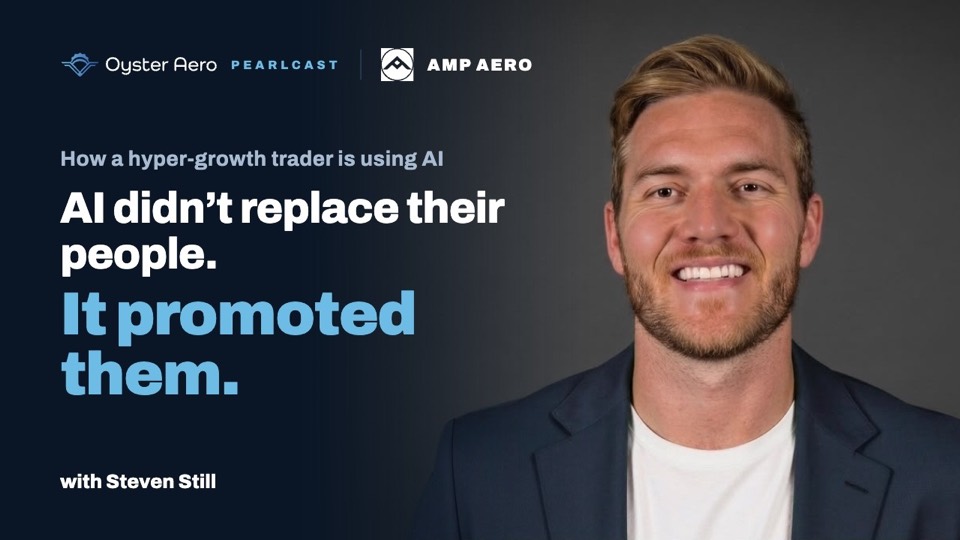
How is a hyper-growth parts trader using AI? Steven Still of AMP Aero joins us to share how the company scaled to roughly 100 people across five countries, and how he built AI into the back office in house. Among many topics, Steven explains why AI didn’t replace AMP’s people, it promoted them: no layoffs, just team members moved from data entry into higher-value work. And when you call AMP, you’ll still get a real person on the phone.
Thank you to our friends at Turbo Resources for sponsoring this episode!
Transcript
Read the full transcript
From the episode's captions, as published. Words that can't be made out are marked [unclear].
Welcome to the Oyster Aero PearlCast, where we sit down with founders and leaders shaping the aviation industry. From freshly formed startups to the biggest names in the sky, this episode is brought to you by our friends at Turbo Resources in Phoenix, Arizona. Now operating in 450,000 square ft of state-of-the-art warehouse space, Turbo continues to keep the aviation industry flying and is actively buying material. Now, we hope you enjoy this episode. Hello everyone, Jeff Jerge on the Oyster Aero PearlCast and my friend and colleague Steven Still with AMP Aero. How you doing today, Steven? I'm doing great, Jeff. Thank you. Good. Now, normally you're traveling around in [unclear], South America, Europe, US. Uh where are you today? I am in our uh Kansas City facility over here, AMP Aero KC. Nice. Nice. Yeah.
All right. So, um I think today's topic obviously we want to just uh kind of learn on how AMP Aero was formed and how you guys are doing, but today we're also going to talk a little bit about AI. So, um let's start with AMP Aero. So, when was the company founded? Who are the founders? Why did you guys get organized? All that good stuff. Yeah, I'll try to take a very long dramatic story and summarize it into a few bullets. Uh, so we were founded around 2020 um by Alvaro Pereira. He is uh founder and president of the company. So, he had an idea, you know, wanted to get into his own business. I think he sold his boat, got 50 grand, and uh started trading parts. From that point, it was Alvo and his brother, added on a couple people, then they partnered up with um Embolic Agarwal. So, Embolic came in as a uh 50-50 partner with with Alvo. They ran it. Embolic did what Embolic does, which is sales and created opportunities with deals. Fast forward to 2022.
I linked up with Alvo and Embalik. Uh I had my own business called Myriad Arrow. We did some JVS together, got some deals going. Um noticed some synergies between both companies. So we decided to do a little merger and acquisition. So Myriad was uh acquired by AMP Aero in June of 2022. At that point, we brought over our inventory, our contacts, and since then, we've been roughly doubling revenue and size every single year. I think when I joined, there was nine of us. Uh we now have about 100 employees across India, London, Istanbul, Kansas City, Miami, and then some remote employees all over the world. So, yeah, it's been a it's been a fun ride and and we're really happy. That's incredible. Um, as far as like content, um, did the business start with engines and kind of go into airframe? Was it just whatever opportunistically sort of was out there? Like what's the, you know, what's the what's the content these days and and kind of how that's evolved?
Yeah, I mean, I guess when we started it was all, you know, individual um, expertise. So, Alvo started, he has a strong backing and airframe. Um the 737 classic, some QEC material. So he started there. Embolic is a monster. Uh very strong in engines, uh but also very opportunistic. Um so today I would say we're probably 75% engine material, 25% airframe. We're really heavy in the V2500, CFM56, 5 and 7, PW, uh, CF-680, and we're expanding into the Leap, the GE90, as well as the respective aircrafts. Very cool. So, all right. Um, on the engine side, and then I guess before we get into some of the AI discussions, like it's been such a fast growth trajectory. Well, I'm going to ask two questions. How have you been able to manage that kind of growth? That's a lot in three years.
So, the growth if you if you look at it as as a business and any business owner or somebody who's scaled something up and built it, you have um right, you have revenue, you have uh profit, of course, you want to grow those. That's great. Um and it's a challenge for us that wasn't necessarily the challenge. We were growing revenue just fine. Our profit and profit margin was great. As we started expanding and adding more people, then it became, hold on, we need to take a step back and restructure this organization. You can't operate as a, you know, a 100 person company as you did as a 10-person company. You have to define some roles. You have to still give people the freedom and the flexibility to perform their duties how they see fit without creating silos and uh, you know, these these departments who don't talk to each other. So lately our our biggest challenge and I guess our opportunity is how do we restructure this organization that flows where we're still fast, we're still flexible, but we do have some, you know, SOPs in place or we're following a process or communicating internally. So our challenge has just been managing the extreme rapid growth and structuring the company versus, you know, trying to grow. We we can continue to grow and I have no doubt about it.
But what pieces are going to fall when that happens? Sure. And that probably does lead into AI a little bit. And what prompted me to reach out to you is I've wanted to talk to AMP Aero for a long time anyway on the on the podcast, but um I think I saw that you were speaking at an MRO event maybe on AI or maybe it was another one and a engines or something like that. But um and and I happen to be, you know, we're all rapidly getting into AI, but um I mean you were thinking about this stuff before we were all talking about it. I noticed that because I mean you're my friend too and and we were chitchatting a little bit last year and you were like, "Hey, uh I'm working on this kind of stuff." And you were almost pushing me at Oyster as well. So thank you. But um so let's kind of just get into the AI side because I think it does relate probably to your growth and to you know some of that. So where do you want to start with it? Like um you know just in general like how did you first look at AI? How are you thinking about it now versus then?
Yeah. So my background um I've always been a techie guy, right? when it goes back to the AOL instant messenger days, you know, um you know, my friends and I, we would create files that could shut down somebody else's computer, right? Hey, check out this video. They double click it, they come back online 10 minutes later, hey man, that wasn't cool. So, there was always an interest in in computer. I have no coding or technical background. Um, but my first job out of college was with a tech startup in Kansas City and I was selling geospatial data. So it was a a SAS product that I was selling to government entities. So I got to work closely with developers, front end, backend, designers, kind of what it took to build products. Um then I got into aviation and for all of us aviation guys and gals, we know that this industry is historically behind in the tech compared to where the rest of the world is um in different industries. So going from a tech startup into aviation and I opened up our ERP and I said what is this? I I have to click here and go there then I have to you know fax. People were still faxing quotes and my mind was kind of shocked. Um but I didn't have the technical capabilities to do it.
So I reached out to people and you did a quote for a million bucks to redo it. Okay that's not economically feasible for us to do. So let me just bank all of these ideas that I had. Then in 22 23 chat GBT starts rolling in and you're playing around with it and my first problem. So I am obsessed with efficiency and workflows. It is the core of my being. If I see something that takes seven steps, I want to figure out how to make it two or how to make it one. And it just consumes me day in and day out. Um, so we had these PowerBI dashboards that our IT provider could only update. We didn't have a PowerBI administrator on site. So, you know, I'm saying, "Hey, I want this table to be changed. I want it, you know, updated to the to to to show this." Okay, that'll be, you know, $500 and it'll take two weeks. What do you mean? Just put that column in there, right? Everything's easier in my mind than I guess in reality. So chat GBT rolls in and I'm like, well, I don't know SQL, but let's see if chat can can help me. So I got access to the database and I'm pulling SQL queries. And at that time, it's not great at running SQL queries. It can kind of figure it out, but you couldn't really link it up to your your architecture or your database. So you're you're you're playing and I don't know the background database, right? I don't know what CMP auto key drives to or what STM auto key is. So I'm learning this as I'm going with chatebt and it eventually starts teaching me SQL so I can ride it pointing it in the right direction. Um, fast forward, the models are growing rapid. Every month there's a new release, there's new this, new that. So, as I'm learning, the models are getting stronger. And then you start seeing these companies come up with, hey, uh, you know, text to SQL. You can write, you know, a prompt in here. It'll query your database and then we'll spit it out. That's amazing. That's what I want.
How much? $80,000 a year. No shot. I'm not paying $80,000 a year. I'm going to build that internally. So it just happened that we started just with this PowerBI and then the models grew and we had already put our database and our systems in it. So we started growing and then we said okay forget PowerBI we can visualize this data on our own. So we started hosting our own visualizations started connecting it made the connection into our database and growing. then the models grow even faster and it's like whoa we don't need to just be doing visualization what other workflows so I took a step back I got with my partners and I said let's just scope out our entire business where are the bottlenecks what's causing the most amount of pain and the first thing that you want to solve is what is a repetitive task that the employee or the team member hates doing right if you can automate that one you're not taking something away that is giving fulfillment to a team member you're just taking something that needs to get done, but it's just repetitive and it's burning hours. So, I sat with every team member in the company. I said, "What are you doing? How do you do it? Show me." And I sat back and I watched. I know. Do you enjoy doing that? No. It's the worst part of my job. I literally dread coming here every day because I have to do this. Okay. What could you do if I gave you if I automated this? What could you do? I could do this. I could do that. I could do this. That's some value ad.
That's where I want you to be focusing, not on this. So, hold on. Let me get with uh AI and try to automate this. And you you've looked at the system, you write it. Maybe it works, maybe it doesn't, but you keep iterating iterating until it clicks. And now you've automated that process that was taking 40 hours a week of one employee and they hated it. And now it's just done in the background. It's automatically done. That's amazing. Now, let's do something else. And I just went from department to department, employee to employee, and I tried to solve all these projects. Now, I have a business to help run. I got a lot of stuff going on. Um, my partners at the time were a little pissed off with me, right? They're like, "Steven, why are you out doing BD deals and why are you running around talking to accounting and this that?" Yeah. Yeah. They at the time, they didn't see the vision. And I don't blame them because that's exactly it. Steven, I need you on the road. Steven, I need you doing this. Hey, we got to handle this. We got new assets coming in. I said, "Guys, just trust the process. Let me keep working it." So, at one point, I think I had 18 projects going at one time, right? I'm I'm I'm over here working with accounting. Now, I'm working with operations. I'm trying to redo our warehouse scanner. I'm trying to show capacity in our warehouse with AI feeds into it. Uh repairs department. I know this is getting a little excessive. I need to hire some help. So, my core focus with hiring comes down to college grads. I recruit um from any college in the nation, but mostly locally to Kansas City. I offer an internship program. If they work, I hire them on. Uh so, I went out and I hired a software developer right out of school and I said, "This is the vision. This is what I want." And pairing up his technical knowledge with the vision that I had just skyrocketed skyrocketed our our results.
and also the the uh protection u the security of the system all of that I've never been mistaken as somebody who's overly you know secure I'll just say yeah just do it just go and he would say no let's pause we need to have this protection in place we need this authentication so we ramped up that the projects were flying um at this point we have three of our departments completely transformed we still have some more so we hired on another software developer and we just took it further and further and further and now we're at this point where our company is very heavily automated when it comes to the back office and a lot of the repetitive manual tasks. Now it's the the the real needle movers um on on different aspects. So now I I I tell everybody my my favorite saying is at in today's current world you know landscape you we can do anything we can absolutely do anything the only limiting factor is what you can think of if you can think of a good idea and you have a good idea bring it to the team and let's build it and we have uh you know given I would say in my Kansas City office everybody here is on a cloud max subscription they have unlimited access to build and create whatever they want. If somebody comes to me with an issue or I hear them talking, I sit on the floor uh usually with everybody else just as I like to hear the chatter. Hey, I'm struggling with this. Pause. How could you solve it? In a perfect world, how could you solve it? Well, it would do this and then it would do that. Build it. Build it. Create create a draft. Um send it over to us for review. So now my team is doing this. They're problem solving.
They're building their own solutions. uh in beautiful beautiful ways that we might need to tweak a little bit, but I'm empowering everybody to be a problem solver and not just sit back and wait for an IT team to do it. You have the skills, you have it, build it. That's amazing. And then obviously, you know, there's a lot of fear out there where well, there's a couple things. Uh one is well my job, even people that hate doing stuff, right? and and and you as a startup, maybe it's not as it wasn't as prolific, but general population, even within our industry, you have somebody that's like, "Yeah, I like filling out the quote and talking to my customer on the phone because that's how we stay in touch, right?" So, there's there's some worries around that. But what I find is if you're not doing all the excuse my French of of just all that manual work, now you have the ability to really collaborate with your customer, right? you're not typing out forms and updating ERPs in 65 different screens and you know you can really get strategic. I mean are you finding that in in practice as well?
Yeah, that's a a great point and another one of my core beliefs. I will never take this company to an automated response and and dialogue with companies uh with customers. You will never get an AI agent who's communicating with you. You will always have a salesperson to talk to, pick up the phone to email directly. You'll get an auto quote. You'll get um tag trays, pricing automatically. That's the customer. We put ourselves in in the shoes of the customer. The customer wants an answer fast, right? I will automate that. But when they want to talk to somebody, talk to somebody. Um and then the second point is you know what does it do to job replacement and and uh you know people's job security is shifting the roles. So we haven't laid off anybody but we have drastically shifted roles. Hey your job was to enter freight invoices from FedEx and UPS and and throw them into Quantum. No longer are you doing that. We can automate that process. Now, your job is to run analysis on our freight costs and our expenses and the routes that we're taking and the shipments and dig into there. So, I need to see somebody who isn't just doing a data entry, but they can be expanded. And if you hire the right person, which I think we have for the most part of our company, I'd say 99% of our company, we have those right people that are being underutilized in their current role and they can expand and do more. So, we're just re-shifting them rather than replacing them.
I predict that most people are underutilized that it's not like, "Oh, we're going to get rid of you." That we can that you're you're and and to me like there's so much negativity and fear, but think about if you had the freedom to do what you're empowering your people to do. Like, hey, you can do anything you want at this company with a good idea and implement it. And if it works, great. If it doesn't, great. like you have like imagine that freedom. That's got to be, you know, really really cool. And that's the kind of employees that any enterprise moving into the future would want, I would think. And and that's it. I remember early in my career, right? I'm a really hungry, aggressive individual and I just want to solve some problems. And I remember getting roadblocked, right? Rightfully so. probably 80% of the time my idea was ludicrous and it could have tanked the entire company, but I just never had the freedom to go and try something. Just let me try. Let let me fail. Let me try and fail. Um, and it was always like, no, that's not your job. No, you can't do that. And that's the opposite of what I wanted this company. If you have a good idea, I will bend over backwards. I'm available 247. I'll give you any tool you need.
Try try to solve it. And uh people enjoy it. At least it looks like my team's enjoying it. Yeah. Um I think they are because most interactions I have with them, they they seem pretty on it. Um so I Let's talk about like where AI is today. Um how is it for, you know, inspecting a terabyte of data worth of engine trace? Is it is it pretty good or is there still some hallucinations and things to catch these days? What it comes down to is is putting in the time to training your models or training your system to do what you want it to do. Yeah. If you just log into, you know, chatbt claude and you dump in a uh tech technical package on an engine and say, "Hey, does this have everything I need?" It'll look it'll grab online, look at sources, it'll do pretty good, right? Uh just just for for as little effort as you put in pretty good, but it's not anywhere up to standards of what you would want in the industry or or that what you would trust.
So, what you do is you plan out those workflows. You plan out what you want it to do. I want it to be my engine uh review or I want it to be my my trace guru, whatever you call it. So, you feed it models. You feed it. You feed it history. You feed it different tech packages. You tell it what a good one looks like, what a bad one looks like. You do that over a dozen, 20, 50, whatever, however many you have. You give it access to point to those. And you tell it, "My commercial trace needs to look like this. This is a non-negotiable. This is 50/50." You train it, you save it, it'll spit it out. It will with your new models, your Opus 5.5s, your Fables, your Astras, it is rock solid. It will do it. We have trace now, you know, just speaking to the trace point. Um, a huge time constraint was my shipping team. Whether it's on the inbound side receiving an organizing trace or on the outbound side, we have a consignment. Half the documents are in SharePoint.
Half of them are in our ERP. Half of them are in somebody's email inbox. Those days are coming to an end. I have systems that will scour SharePoint ERP and personal employee emails, compile it, put a cover sheet on it, and send it out the door. Right. Because we've built the systems of what good looks like and what bad looks like. Right. You're you're ahead of the curve there. All right. Yeah. Confession time. Um, do you have a personal assistant cla agent? Because I built one and it's crazy. Well, let me explain mine. It reads my emails. It reads my text messages and looks at uh meetings like this with fireflies or whatever. And I it's built now that it says, "If you think I have an action item, hold me accountable to it." And it texts me three times a day. So it's likeing it just like just that like it's helped me stay on focus to make sure that the priority items are getting done. So have you have you gone down that road yet? So I've gone yeah I' I've gone down it I built out something internally uh I called my first iteration sterling and it was communicating with the team right and it was mostly not for personal but getting updates from the team and it was answering some requests and uh I didn't tell anybody it was AI so I I'm getting texts from the team hey we hired this this person named Sterling what's going on and it was it was good um but I kind of retired Sterling so now our agents uh I have an agents for uh updating orders and keeping orders and and data integrity in our system. So it'll read everybody's emails, it'll read everybody's system updates and it'll help guide them to update, you know, estimated ship dates, uh order accuracy, things like that. So it works more in the background for the company than personal personal use.
Yeah. Yeah. It's um man, it can it can remind you to pick up a bottle of wine if that's what you're supposed to do for a dinner party. It's pretty amazing. Um, great. Very cool. So, I guess, um, it's really hard to predict, right? And I don't think anybody really knows what's going to happen, but you know, my kids are in college. I think your kids are younger. Um, so, you know, what do you tell the next generation? You know, when you're talking to kids, like what what's in your mind for them? What do you think they should be focusing on? So, yeah, my kids are three in one. Um, yeah. So, that they got a little bit to go, but I have no idea what's going on in their future or what's going to happen. Uh things that keep me up at night is thinking about my three-year-old and my one-year-old and what their future looks like and and jobs. So, hopefully I can do a good enough job where if it comes down to it, they don't have to worry about it. You know, they're they're they're protected. Um but in the more immediate generation, like I said, I spend a lot of time talking to college and university students. Y um I interview them constantly. I go to career fairs, uh high school students as well. In the immediate time, learn to utilize these tools. Utilize them, build things, create things, solve problems with it. Go a step further from using it as a uh just a chatbot, like a a glorified Google. really try to solve a personal problem in your life and build and and work on that because if if I'm looking for people who can solve problems now people who know how to identify problems and rather than say oh yeah there's a problem they're saying I can solve that problem I know how to solve it um or at least I I can take a a stab at solving it so I'd say right now utilize the models however you can to solve problems and if you can do that and understand the full capacity of it right? There's changes coming out constantly every day.
There's new releases, new model updates, you know, new tools. Stay up to date on all of that and that's what I'm looking for. Um, and I think that's really really important for the next, you know, grads or people coming out in the next two to five years. Um but then again it's hard to tell because six months that's kind of you know the cycle when something new comes out that completely revolutionizes the uh the industry or or software. Um yeah but at the end of the day all this is at least for now I mean not for now but it's it's really helped AMP be a better company. I mean it's it's you can respond faster but you also have human accountability it sounds like as well. Yeah. We will never lose the human aspect. We will always be over uh oversaturated at shows. We'll be there. We'll have a big group of people. We have I mean we have 18 or 20 people on our sales team. Uh if you call if you call our phone number and you want a quote, you have at any given time eight people fighting over that phone call, right? We run time trials on how fast people pick up the phone just so you know you can always get a hold of somebody. You're not it's not going to be ringing and you can't reach us.
Somebody's fighting for that call. Um so yes, the AI has taken away a lot of the backend just redundant tasks and freed up our sales team to have those face-toface conversations, meet with you, find out your needs, um and solve some problems. That's cool. All right, Steven. thanks for taking the time to hang out with us today and especially talk about this topic. Yeah. Yeah, definitely. Thanks, Jeff. All right, be good.