PearlCast › Episode 32
Episode 32Oct 24, 202629 min
Ella Lucas-Averett, The Trivista Group
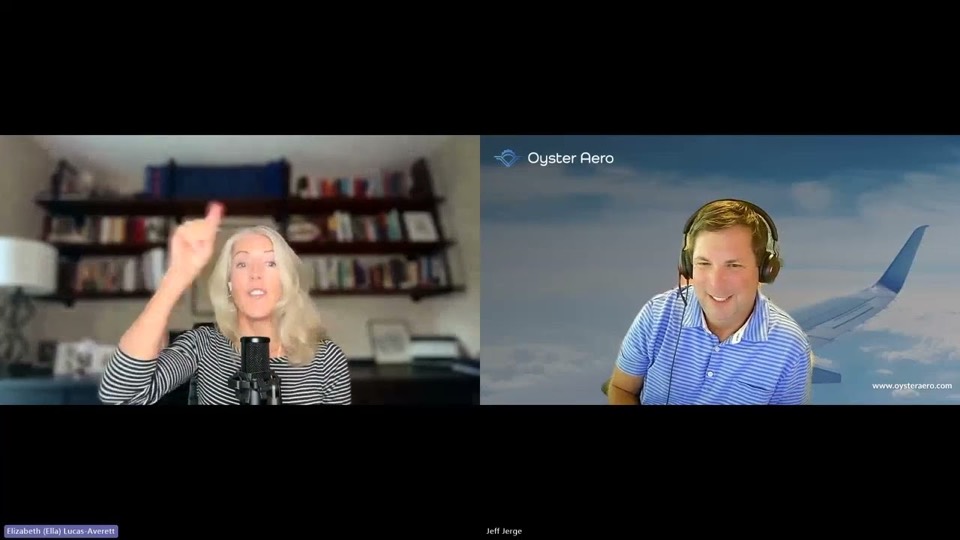
About this episode
Check out this episode with Ella Lucas-Averett of The Trivista Group, a boutique strategic consultancy for aerospace and defense companies. Ella has spent 23 years embedded in the industry and walks us through what really happens when cultures collide during M&A. She explains why “soft skills” are actually hard business levers that hit EBITDA, and how leaders should think about AI: productivity win or just doing more nonsense faster? She also makes a powerful case for leading with excellence without running your people, or yourself, into the ground. A little different from our usual founder conversations, and one you won’t want to miss!
Be sure to check it out!
Thanks to our sponsor, Turbo Resources in Phoenix, AZ!
Transcript
Read the full transcript
From the episode's captions, as published. Words that can't be made out are marked [unclear].
Welcome to the Oyster Aero PearlCast, where we sit down with founders and leaders shaping the aviation industry from freshly formed startups to the biggest names in the sky. This episode is brought to you by our friends at Turbo Resources in Phoenix, Arizona. Now operating in 450,000 square ft of state-of-the-art warehouse space, Turbo continues to keep the aviation industry flying and is actively buying material. Now, we hope you enjoy this episode. All right, hello everyone. Jeff Jerge with the Oyster Aero PearlCast where we interview founders of aviation companies. And today is a little different spin. We have Ella Lucas-Averett with us from the Trivista Group. How are you, Ella? Hey, Jeff. Thanks for having me. All right. So, um, the Trivista Group, let's see, that is a strategic consultancy primarily for aerospace and defense customers. Right.
Right. But what does that mean? Right. [laughter] Sure. I I actually started off doing strategic consulting for really rapidly growing companies but ended up very early on in the history of the Trivista Group. Uh embedding in aerospace companies and I never left. So it happened quite by accident. 20 23 years ago now I suppose. 23 years ago. And you started in aerospace and defense. So where did you start in the industry? Yeah. Yeah. It was 2003. So I I had actually been working in the financial services sector again as a growth consultant but uh I left business school went to work for this company based in London and really we were we were quite centered on financial services but I took the model that they were using which was client development and supplier development notably and brought that model back to the US with a few people that I worked with at that company in London and very very early on landed um landed a conversation with a with a company called Be Aerospace. So, a lot of people might be familiar with that. They're now Collins. Um many many iterations later and honestly did maybe a supplier workshop for them like a strategic supplier development initiative and never looked back. this industry has grown by acquisition and insane growth numbers uh as you well know and so it's it's been a journey. It's been a real ride.
Isn't that funny how once you're in you're in you never leave and if you do you come back. I actually I actually I do a lot of public speaking and one thing that I invariably joke about because it remains true is everyone thinks their industry is unique or special. This one really is like this one really truly is. And it takes a special kind of person to really be passionate about the aerospace industry. At least that's been my experience. It does. It does. And I pretty much met you recently at ACPC where you led a panel for airline buyers and what they're looking for and all that. So that was super interesting. Yeah, that shout out to Karen Cantor and the ACPC team. They do a brilliant job. uh supplier. It it aircraft purchasing conference uh for anyone who needs context. But yeah, was fortunate enough to be on a panel with some airlines about what airlines really want, which as you might imagine to a bunch of procurement uh managers and folk uh was very interesting and then also uh delivered a keynote that may touch on some of the themes that we talk about today. But um yeah, and that one that one was delivered just to the airlines exclusively. Got it. All right. Well, um, yeah, I knew when I met you because we're doing Oyster University and all kinds of things that we would just be two peas in a pod. So, uh, welcome and looking forward to it. So, um, all right. I I guess normally I interview founders of aviation companies, the people that are moving to metal and all that sort of thing and you consult all these functions and these executives both at small, medium and large companies, right? Um I guess from a founders's perspective of a smaller company, you know, startup, what are some things that you have found that people do really, really well and what are some things that you found that people can improve on in your experience going all over?
Well, first if you don't mind, I'll lay a little context so that you can decide whether you know the utility of this information or [laughter] not. So my business is a boutique consulting firm, right? I mean we're very very very small by design and we are really operators. So we will go into a business just a very few of us three Trivista um we will go into a business individually working one-on-one with our own clients and really get our hands dirty in the business where improvement is needed. So when we say that we work with rapidly growing firms almost exclusively that is a little bit misleading because it's not always growth that is the major transition a company is going through. We also work with people who are just in some other similarly almost disorienting juncture of transition. So that might be a spin-off. Um, you know, I've been involved in spin-offs to a a publicly held company. Um, big big big acquisition. Um, we are involved heavily in PMI, so post merger integration work.
um almost always periods of rapid growth, but occasionally brought in when the business is actually experiencing the inverse and things are starting to slip. Um and they need to sort of get boots on the ground, figure out what's going on. They don't want some big firm coming in bringing 12 people in briefcases and charging them $2 million to do an assessment um to to take off your watch and tell you what time it is, as the saying goes. Um, so we really are more operators than consultants, but we can sort of be deployed 82 airborne style. Uh, where more process is needed, where boots on the ground are needed to assess what's actually going on. Um, where you're starting to lose people in terms of engagement. I don't mean you're necessarily experiencing turnover, maybe not yet, but you sense that there's a lack of engagement or perhaps just that there's an opportunity for more. Um, so that's the that's the world in which I operate. Does that raise any questions for you before we before we jump in?
No, it it it does it helps lay some context. I guess one thing that I'd like to clarify like are you focused more on like the financials of the business on the or chart on the culture like where and consulty would you say would be an expertise? Great question. Not not strategic finance. No, no, no, no, no. And and frankly what I have found in my experience is that's something that most of these businesses are doing really really well. Um almost almost at the cost of some focus on some other functions. Um so highly highly operational and then people and culture. So got it. So so let's say supply chain and sales are you know there's a disconnect. Um and there's always going to be an inherent tension between operations and sales or procurement and sales. Like that's as natural as natural law. Right. Right. But when the friction is costing you profits or efficiencies which will eventually cost you profits. Um or when they are there's just an utter disconnect and your functions are operating in a siloed manner. It's one thing to know that that's what's happening. It's quite another to be able to dedicate the focus to fixing it. And again, like you can hire the big suits and they'll come in and do an assessment and they will provide the bar graphs that tell you what you need to do.
Whereas if you drop me in there, I'm going to pull those teams together in a room and we're going to process map and we're going to uh talk about the things that are actually holding us back, the stuff that you can't put in a memo or maybe shouldn't put in an email and have the real conversations that reduce the friction. And then we're going to attack the processes together, which creates buyin because we're solving this problem together. And then we're going to produce something that the business can feel inside of 30 days. And like it's like putting oil on the um and results in actually knowing what's going on under the hood, you know? Interesting. I mean, you did touch on something. There's always the published or chart and then there's the unpublished or chart, right? I mean, that's just kind of how it works. I tell you what, you have people with the titles, right? And then you have the people with the influence. And shame on the person who thinks that those are like a ven diagram that completely overlaps because that is absolutely false. And what a lot of times people do is they rely on the titles and they don't understand the influence. So they don't understand the influencers who may be influencing in a positive manner and they may be detractors, but it it's costing you if you don't know who they are and you know frankly how they're influencing. Um, and so yeah, that's one that's one branch on that tree, Jeff. For sure.
Sure. So, I guess there's no shortage of M&A going on right now. I mean, there private equity has been coming into the MRO space and now they've been picking up parts traders and and all kinds of just crazy M&A activity. So, um, I guess live, what are some of the things that you're seeing as these cultures collide? Is it overlapping things? Is it just mismatch in um you know cultures? Is it private equity mindset versus ownership? Is it you know once you go public there's a whole another set of issues there. So what are you kind of seeing and what are some of the um not landmines? I can't even think of the right word. You'll come up with it better than my question. [laughter] Okay. So first of all to all of the factors you just named my answer is yes. Yeah. I'll take like E. All of the above. Um 100% yes. And it's really interesting when you when you look at the numbers, Jeff, because McKenzie is constantly telling us that 70% of mergers fail to deliver on the synergies expected. 70% fail to deliver as expected. It's pretty big. They actually say 70 to 75. I'm going conservative here. [laughter] Sure. But the primary cited reasons are people and integration issues.
The number one driver behind that wildly high number is people in integration issues. Okay? So if someone's coming at me telling me that people in communication are a soft skill, like they're not paying attention and they you know they are not paying attention. And Gallup has one more one more little one more little metric I'll show you throw your way. One more little metric I'll throw your way. Gallup has a global workplace report that they're known for. They come out with it all the time and they they consistently show that low engagement actually costs organizations roughly there's a little bit of fluctuation roughly 18% of annual salary per employee and loss productivity. Like if you don't think that's touching ibida again you're dreaming. So, so there's no such thing as a soft skill in my world at all. I don't mean it's not possible. I just mean communication and engagement and knowing what your employees are saying and doing and how much buyin there is and whether they understand your vision and whether they understand the mission and how connected they are to that on the day-to-day. those are hard business levers that show up in your numbers. So, that's sort of my operating thesis. Uh that's that's kind of where I start. Um but yeah, if you want to peel back the onion on what those mistakes look like, I'm happy to.
So, take your headcount cost times 20%, you know, you have that efficiency already going for you on a good day, basically. I mean, it's brutal, right? And the thing like that's the bad news, but the good news is this is so addressable. Like this is so utterly addressable. And the mistake that I think we make is largely like hubris in thinking that oh I have a vision and I've said it out loud before therefore everyone understands it. or we have our purpose on our website, so we all know why we're here and we all get it. And and like sort of conflating that with winning the hearts and minds of your employees and everybody kind of knows what they're knows what they're working toward. Um, and I'm not just talking about, you know, the rainbows and sunshine and the happiness that comes when we all know why we're showing up at work every day. That's a real plus. I've already made the case for that. But I'm talking like in brass tax, clarity, consistency of message, awareness around what your objectives are, knowing that even though there's an overarching vision andor mission that starts at the top, does each function first of all, can they repeat that back to you word for word? If I asked 10 people in your company why you exist, am I getting 10 relatively similar answers? You'd be amazed.
[laughter] Okay, so let's start there. But secondly, and this is even more disruptive to the day today, each function, their own goals and their priorities should perfectly align to that greater vision and the operating plan pillars that you have set forth that I'm sure everybody knows and everybody's perfectly clear on. Right. Right. And they should every single one of their goals should feed into one of those pillars of your operating plan which is supporting your vision. Okay, let's just start there. Some people will be hearing that and be like, "Oh, I've got some work to do." [laughter] Like there's no there's no playbook. There's no master plan and therefore it can't be consistently and clearly communicated. Um very addressable but not easy necessarily. Got it. Um and understandable. I mean then this is at companies of all sizes. If you think this isn't a you know five person companies it is right. I mean just not as it's just not as buried I guess.
Literally I don't I don't work with too many companies that are on the small end anymore. Every once in a while I will just sort of fall in love with an owner and really like what he or she is doing with his or her business and like want to get involved and help someone who's just sort of getting off the ground. But I tend to work now with companies in the $350 million to about $1.5 billion range. That's kind of my sweet spot and frankly where the industry will lead you. um during times like these. Um but for to just to drive home your point, if I'm working with a founder operator or a company deciding whether it's going to IPO, I'm having the same conversations. Yep. Yeah. As you would at smaller for sure. Okay. I have one and I'm going to put you on the spot because it's not fair to put the future of the world on you, but um I would imagine there's a lot of I don't want to say distrust, worry on AI and replacing jobs and coming into companies and you know and I know you're out there sort of every single day so I wouldn't ever ask you to predict what where AI begins and ends but um I guess in general eneral, where are you seeing executives leadership on the topic of AI right now? And then how are you managing quite frankly, I would imagine the fear from the rank and file, if you will, on what does it mean for me? I mean, you've got to be saying that, I'd imagine.
Interesting. So definitely I am no expert here and I can only answer from sort of an n equals one observation point of view but I actually find it quite interesting. So I'll share I'll share my n equals1 observations with you. Sure. Most companies that I talk to, whether it's a carrier, whether it's a manufacturer, whether it's a distributor, okay, they don't know what they have. A, like many of us, right? B, they're very excited about the productivity that AI can deliver. Almost the productivity hacks, if you will. And they certainly are becoming more and more at at an incredible pace, more and more literate in the productivity that can be achieved with an AI layer over day-to-day operations, if you will. Okay? But put a pin in that because the gaping wide opportunity that I'm seeing again from from my my corner of the world is it's not yet clear how it will solve real problems for them. So what I mean is will it help them with demand planning?
Will it help them alleviate pressure on the supply chain? Is it helping them clean up the order book? Is it helping them I mean all of these things that plague our industry. the big strategic issues, the the kind that when you pull on one thread, it like yanks 50 over here that you didn't even know it was tied to. Those big issues I do not yet see. Now, by the way, AI is moving at such a pace that this conversation might be obsolete in two weeks. How do we know? Absolutely. I know that's a disclaimer, right? Thank you for saying it. But I'm seeing it helping with reporting. I'm seeing it help as a layer over their ERP. I'm seeing it help with things that do clog the works like, you know, emails and and data uploading and and that sort of thing. But I'm seeing it probably at a factor of 50 to one on tactical items versus solving big strategic problems for us. And frankly, I'm okay with that. I'm okay with that. [laughter] I love a human. Yeah. I mean it the way I kind of have seen it is um everything that you said like it's giving insights into the business and it's doing some of that labor and maybe just the way I am. I don't want my job to be I type 30 emails a day. You know I just you know if it can free you up to actually get strategic on the company and strategic in your job and actually making a real impact in those other things I mean why wouldn't you be excited about that?
But here's the thing that I think that we have to pay attention to because we said this about um Blackberries. Remember remember for some of you I wanted one so bad. Yeah. These will be the the devices that your ancestors used. But in any case when Blackberries came out we were like this is going to make us so much more efficient. And in a way absolutely did it. But what did it also do Jeff? It also expanded our accessibility to where there were no more borders between days, right? There was there was there it's 24 access, 247 access theoretically to whomever you needed to reach. That has very obviously only increased at scale and scope very obviously. Um, and I think that this industry and every other one needs to pay attention to are we using AI to streamline processes or are we using AI to create more hours in the day for us that we spend on the wrong activities still not doing the things that make a business special and profitable.
Right. Right. So, so just, you know, the nonsense will expand to fill the void. So, Sure. Of course. Yeah. And I guess I mean certainly at a strategic level, I mean, you're not going to walk into a board and see them all in the boardroom asking chat GBT what they should do. The the human element has to be in there, right? I mean, it just So, I I think I think it seems like what you're seeing and what you're saying is sort of a very logical place in in kind of what's going on. So approach with caution and also also to what end like whatever we're doing whatever we're discussing whatever um AI process we're evaluating for our business to what end what tradeoffs are we making what will we do to fill the void that this supposedly creates for us the vacuum the emptiness the white space what will we do with that and then how is that in service to this company our customers and our people Like if we go through that intentional thought process, you know, the sky's is the limit. When we just sort of adopt things at pace without judiciousness, we set ourselves up for just more noise or just doing more nonsense faster.
Yeah. Yeah. I I'll tell you in my little world of supply chain, um, you know, even when I started Oyster a couple years ago, we attempted to limit the amount of RFQS somebody gets because we wanted to show buyer intent and the conversation I just had at ACPC because people are bringing AI into their reading of quotes and answering them back and all that. They're like, I don't care if I get a 100 RFQS, a thousand RFQS or a million. Doesn't matter because our business rules are going to process however we do. So we've even made some shifts recently where we're becoming a lot more AI enabled and friendly and all that sort of stuff to kind of accommodate this new wave. So that's and the best companies that I know of where I really really like the founders uh or the owners or the CEOs, they seem to be saying like right now we're just focused on AI on internal processes. We don't want it to touch customers just yet. You know, if we can do something a little bit better, faster, cheaper, of course we will. But we still want to be a a hightouch, high service organization and not seem automated or be automated because if somebody has an AOG or whatever, they don't want to hear from a bot. They want to they want to make sure that a distributor is jumping on it and and that sort of thing.
And and I just don't envision a world where relationship is not a competitive advantage. and and frankly arguably now more so than ever not only because of the AI trends obviously but because of what's going on in the supply chain I mean uh for for for a myriad of reasons I'm not betting on the company that thinks relationship humanto human is not a competitive advantage me out right yeah agreed agreed all right so um so what What else is is happening out there that you see that I didn't ask? [laughter] Um I can just share a few other sort of highlevel observations that I'm observing and one of them sounds wild. Like we've talked about Ibida, we've talked about supply chain constraints and so this is going to sound like it is absolutely out of left field. But one trend that I have been witnessing my entire career and has been have been subject to myself, Jeff, is we can get pretty busy. We can get pretty myopic. We can start thinking that what we do in our jobs is capital T the most important thing that has ever happened and ever will. And something that I observe amongst the population that includes us is in that in that trend we stop taking care of ourselves.
We just completely stop taking care of ourselves physically, mentally [laughter] like just all the things. And it is almost like the fact that that sounds a little odd in this conversation is actually the flag. Does that make sense? Like the fact that that actually sounds like how are we even talking about this is actually the yellow flag. I have heard it described that um this is a drinking industry with an aviation problem. [laughter] So no um it it just kidding of course uh that just came to mind when you mentioned that but no I think you're right because it's it's the operational you cannot fail. It's safety sensitive. there's so much stress in the job and then you think yeah like everybody thinks that um their widget is the best and the pressure to stay the best and then yep health is gone mind is gone family whatever that is just it's amazing to see I I I completely agree with you so yeah and I won't I won't beat that horse but I will just say that we need and and and America is particularly prone to this mentality right other countries are not quite as sort of psychotic as we are about about the the so-called work life balance which I think is you know a myth but um but for lack of a better uh label to throw on top of it but when we stop treating ourselves as humans like 360 degrees of a human being Jeff I I believe it makes it extremely difficult to create an environment where we can treat our people as 360° [unclear] humans. Y um people come to work and they have lives and we forget that sometimes in in an effort to accomplish our mission. Um I would submit to you that we can absolutely do both. Um and as a as a big fan of
personal accountability myself, I think it starts with you. So, so to the leaders out there, I would just say um everyone knows someone who gave their lifeblood to a company. you know, you cut them open and they continue to bleed blue. Like they love the industry so so much and they got dumped. They got dumped by their company. They got retired out. They got uh consolidated. You know, pick pick a scenario. Um and that person gave their whole life. They missed all the games, you know, they were on the road the whole time, etc., etc., and they're left kind of holding the bag in the end. It doesn't have to be that bleak either. There are many many many of us who just simply work seven days a week and kind of lose the plot in that vein as well. I would submit to you that it is extremely possible to run a culture of excellence, extremely high quality standards and not, you know, run absolutely everybody including yourself into the ground while doing it. It's not easy though. [laughter] No, it's not easy.
Uh I think many people that are listening to this will be able to relate to that. So, because either we've done it ourselves or know someone that has. So, okay. Well, um, how do we get in touch with you if we want your help? Uh, I have the happy virtue of having with just type Ella Lucas-Averett into Google if you can figure out how to spell that and you will find me. But the Trivista Group, best place to reach me is probably on LinkedIn, Jeff. Okay. Well, um, and then are you gonna be speaking at any events coming up or are we, uh, just burying ourselves in projects now? Thank you so much for asking. I have a private event coming up that I won't bore anybody with and then I will mostly be digging into a couple of PMI projects, some some integration projects. Um, but yeah, hit me up. I' I'd love to meet I'd love to meet some folks from your community. So, I'm sure you can make it easy for them to find me. All right, we sure will. Okay, Ella, thank you so much. This has been um a little different than of some of the conversations that we had, but super enjoyable. Thanks, Jeff. I appreciate you.
All right, take care.