PearlCast › Episode 30
Episode 30Jul 13, 202617 min
Mike Cantave, 2Lyons Aerospace
About this episode
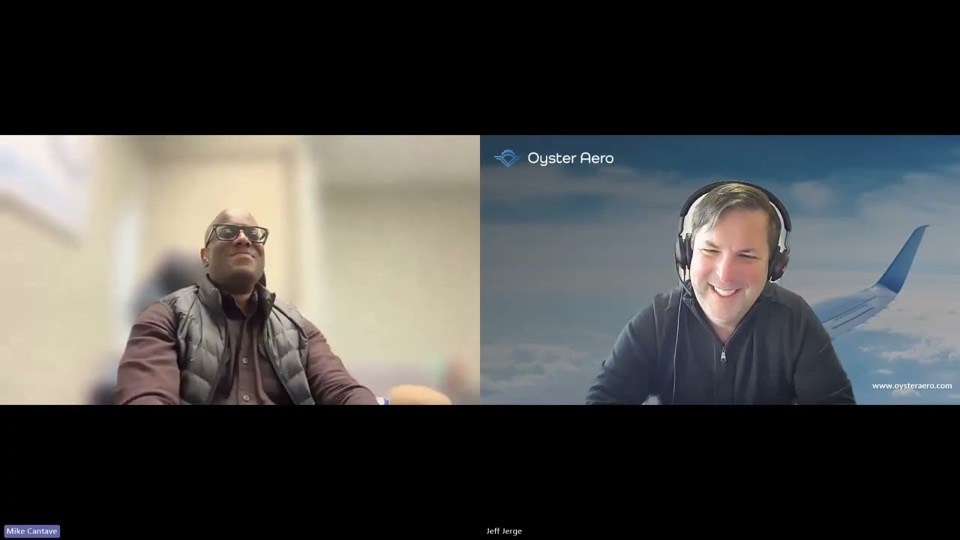
Check out this episode with Mike Cantave, founder of 2Lyons Aerospace. Mike walks us through his aviation career and how 2Lyons was formed, and highlights what it takes to be a founder of a small company that has exploded in the defense aerospace world and now crossing into commercial aviation. Be sure to check it out!
Transcript
Read the full transcript
From the episode's captions, as published. Words that can't be made out are marked [unclear].
Welcome to the Oyster Aero PearlCast, where we sit down with founders and leaders shaping the aviation industry. From freshly formed startups to the biggest names in the sky, this episode is brought to you by our friends at Turbo Resources in Phoenix, Arizona. Now operating in 450,000 square ft of state-of-the-art warehouse space. Turbo continues to keep the aviation industry flying and is actively buying material. Now we hope you enjoy this episode. Hello everyone, Jeff Jerge with the Oyster Aero PearlCast. I am joined today by with Mike Cantave of 2Lyons. How are you doing Mike? doing excellent, Jeff. Thank you so much and thank you for getting my name right because a lot of people don't. So, I appreciate that and thanks for the effort at taking a swing at the French pronunciation. Well, we try. We try. I think my last name gave me a lot of trouble as well.
So, uh we always try to get that, you know, correct if I can. So, um, I walked into 2Lyons a couple weeks ago and, um, I'll say I instantly liked you and I don't I couldn't put my finger on it, but once I got to know you, you said, "Hey, you know, I'm from Memphis." And I was like, "Okay, all right." You're like, "I'm an entrepreneur. We started a business, 2Lyons." And I was like, "Okay, this is good." You know, and uh, then you left the Airlines pilot. So, you know, um just uh at this point, we just need to go to the bar and have a good time and chat for hours and hours. So, that's right. Uh anyway, thank you so much for joining. Um as you know, like these podcasts are kind of about um starting companies and aviation founders and all that. So, I generally start with, you know, we want to learn a little bit about 2Lyons, of course, but when did you start the business? What were some things that led you to starting the business? You know, that kind of thing. So, like what why did you decide to start a company basically in aviation?
All right. Well, first of all, thank you for having me, Jeff. I I know that uh man, you have plenty of people to pick from. So, thank you uh for giving me the opportunity and for having me here. And um yes, Ditto, it's obviously you and I meet a lot of people in our travels. We both travel extensively and it's rare to find someone that has so much in common immediately down to our kids and where they are in their respective trajectories. So, my mind is blown and yes, after this we'll definitely meet up for a beer. Um, of course. But that being said, in terms of the business, you know, they're both tied. Why did I start a business? Well, it's because we did everything that we were supposed to do. Both my wife and I, we went to school, worked hard, followed the rules, but yet my wife was in the mortgage industry and she kept getting laid off and laid off and laid off. That's when the mortgage industry was shrinking. And as far as I'm concerned, as an airline pilot, you know, I started for at the regionals and I was trying to work my way up the chain. I finally did everything right. And to no fault of mine, we entered a concessionary contract during contract negotiation and took a 30% pay cut. I said, you know what? A, that's not fair that I'm doing everything that I'm supposed to do and yet to things that are not of my control, I'm getting penalized. And then B, I need an extra money. I figure, you know what, an extra 500 bucks a month is uh I I could figure out how to do that on the side. So those two things led to me starting a business. Jeff, awesome. So family need um you know they say that that friction creates a spark.
So that's right. That's right. When was this? What time frame was this? So this uh pretty much got on the airlines at 04 then around 08. So uh really I started first as a consultant. I started a small consulting firm because uh my background before being an aviator I was a manager for FedEx. enhanced all the reason why I spent all this time in in in Tennessee in Memphis specifically and one thing as a FedEx manager they put a lot of time, effort, energy into their management. You do all kinds of management training. So my initial gig or or offering rather was offering a management perspective to small business owners. So I started as a consultant to managers that were great salespeople but didn't have great management skills or necessarily systems in place. I would go in and help companies establish systems and management practices. Along the way, what led to 2Lyons is I assisted a gentleman that was already in the aviation spare parts procurement space and um that is how I got exposed to the industry by helping him establish businesses or practice business practice for his company is what gave the idea for 2Lyons.
Got it. And so you're in Memphis and if I recall um 2Lyons started kind of in commercial parts trading, correct? Correct. So we provided u spare parts uh to commercial airlines in emerging economies, you know, places, remote places in Africa that bought airplanes that are out of warranty. You know, places like, you know, Batswana and Zimbabwe and places that a lot of people don't go, however, uh that had a need. They bought used aircraft. They they're out of warranty. So they need to keep their spares going at an affordable but safe manner. Uh was the need that we filled at the time. Amazing. And then um I think when we chatted through the evolution, you started getting a little defense focused which um you know it's interesting to see businesses I I'm always curious. Do they start in defense and go to commercial? Do they start in commercial go to defense? But so you made that kind of transition into the defense world. What was that like? Like like how how was that as far as getting 2Lyons established in that world?
So the the reason why is because as as well as commercial aviation was doing well when COVID hit airplanes weren't flying anymore. So if planes are not flying then there's no need to replace parts because planes are not being used. So I figured well I understood business. I understood aviation. I understood aerospace. to understand how to procure parts. Well, what's the one customer in the US or the one customer that is still buying and it was the DoD, the Department of Defense. Sure. So, that's what led to it. The transition, however, was interesting because I had to get familiar with all the rules and regulations, but this is something that I had always wanted to do. And like a lot of people, I watched that movie War Dogs and man that ignited the fire because I knew how to connect those dots just not with guns but with airplane parts and the US government and our military was a great uh customer with a great buy was a great buyer. So we started and learned the process from the beginning. I I read extensively. It was during COVID so I had nothing but time on my hands. So I read, watched, learned, observed anything and everything that had to do with defense contracting during that COVID period and executed as fast as possible with turning this into a business.
Very cool. And I would say since you made that decision, um, the mix is a little heavier in defense right now, but you still kind of play in both industries, right? Correct. for the most part now the business is 80 90% defense now it grew it exploded but we do still have a presence and uh we offer different offerings now in uh still in the same regions uh outside the United States and you know emerging economies but uh different offerings we we help them with different things such as consulting and things of that nature. Sure. Um, did you find after going through that process like are there are there resources really to turn to to learn the defense industry or do you just have to figure it out? You know what I mean? Like it would be cool if somebody just came along and said, "Here's a playbook. Boom." You know, but I I don't get the sense of that yet. So, no, I I don't get the sense of that. that unfortunately I think you know the people who made the most money during the gold rush were the people who were selling the shovels not the people who actually found the gold the gold and truth be told I think there's a lot of money to be made if someone could take the time to put together a playbook step by step and defense is so vast and wide right and whether it's a service whether it's a good what department you're working for or with whether it's department of education department of defense Department of Transportation.
So, it's so wide. So, to understand the landscape and to narrow it down and to figure out how to navigate the landscape that you chose and even within that landscape, there are so many different avenues. So, yes, it took a lot of trial and error, but we did build on some principles that we learned in our stages in the commercial space. And to be honest, because the business was established on the commercial side, we used some of that past performance. So some of the experiences, some of the past performance is actually transferable and counted and we're able to build on those foundational steps, if you would, that allow us to make headway into the defense space. Got it. Yeah. And I mean, just in my experience, like it's really hard to get established and set up, but once you're there, I mean, you have to perform, but it's really like you're you're then a supplier. I mean, you're correct part of the network and all that now.
I' I've done 30 plus 35ish podcast and I've not gotten to ask ask this question of anybody else. Um, how has your training in being a pilot helped you in your business life? I I think that and I'm and I'm glad to be guinea pig uh for you here, Jeff. That's that's great. I get to check the boxing the first. Absolutely. But no, actually it has helped a lot of doors because at the end of the day as a pilot the the one thing I'm still in the seat. I'm still active. I'm still flying and I get the other end of the spectrum. I get the safety side of it. I get the failures. I get the reliability of the parts. I get what happens if an airplane breaks down. I get what happens when we're stuck at an outstation halfway through. I relate to the passengers. I see their frustration. I understand management's urgency. So all this to say two things being a pilot a who's active gives credibility. I find some vendors have been very responsive to the fact of of that that that's what I do for a living. But also the philosophy has always been because I get it to that extent. If I don't want it on my aircraft, I wouldn't sell it to anyone else. Whether it's a F-16 fighter or if it's a Boeing pilot out in somewhere in a remote region of the world, if I don't want it on my aircraft, at the end of the day, it's not passing along to anyone else because I understand the ramifications at a level that I think most people don't. That has always been our value proposition and I think the sincerity comes across when we speak to that subject.
Wow. No, that's uh that's amazing because a lot of people forget their role even in basic parts trading. You tend to get stuck in the day-to-day and you're not thinking about, you know, what you're doing, your decisions you make, the people that you're using to repair parts, all that stuff. I mean, it just it's it's you. It's all part of the safety culture. Yeah. 100%. Not just the safety. Yeah. The the passengers when they're stranded, the cost to the airline when the aircraft can't fly, they have to lodge these people, feed those people. So all these things and plus you know the person in the seat the crew that's interacting the gate agent that's interacting with those passengers. All these things come to mind when I look at a boat. To me it's not just a bolt. I see the entire line if you would from beginning to end in a way that I think most people don't. Sure. Well I I I knew when I sat down with you that you really attacked things very systematically. Um and it was impressive like when I first met you and then um yeah so so as far as 2Lyons maybe the next wave of growth what are you what are you thinking we know that you've got some commercial business you know you've u supplied the US government done a little bit of FMS and some consulting and all that is it just keep doubling down on that service or are you looking to um kind of expand yet in another channel within that.
No, you know, Jeff, I I I think we've hit the width that we want to hit. Now it's time for depth. And I think it's just doing more of what we've been doing now that we found our way. We found our identity as a procurement partner for the DoD, Department of Defense when it comes to aerospace, aviation, ground support, equipment, and we offer various services. I think now that we know truly our space after 12 years of of being in business, it's time to go deeper and you know now it's to the point where we're starting to be known a little bit and now they come to us as much as you know we we pursue opportunities still but now there are times where they come to us is hey we seen your past performance can you assist with this so it's time to get better at the things that we're known at and the the the I guess the magic is going to be in the depth no longer the width for us. That's wonderful. That's wonderful. And then I guess we'll finish out on a personal note. We realized that both of our sons are also following some footsteps. So mine is uh working on his private pilot through Collierville High School here and uh your son's a year or two, maybe three ahead of him, but he's uh he's building his time as well.
That's right. That's right. He just hit about 750 hours. He needs to hit his $1,500 hours. He's a flight instructor down here in Fort Lauderdale. So, uh, yeah, they're on the same path, just a few months apart. Okay. So, um, he's flying. You jump in the right seat. Are you able to relax and kind of let him take it or is there always that Hang on a second. Let me let me just keep an eye on things. Well, uh, a little bit of both. You know, we're still dads at the end of the day. you know, dad don't get as much credit for how mushy and protective we are of our kids. Now, I'll tell you what, here's one thing, a personal goal of mine that I have. And um, you know, I've flown a few aircrafts or over the course of my career. And for me, right now, I I've have the fortunate privilege of being a a flight instructor or a check airerman at Delta Airlines. And uh I do have this seniority to go to other airlines, but the goal is for me to stay put and for him to get to Delta and for me to be his instructor and to do uh to be his Czech airman and to do his initial operating experience trip. So as much as I cringe today in the right seat, I'm going to put it on pause and cringe again as I sit in the seat a couple years down the road in a jet with 200 passengers. So that's if you had to ask me bucket list item, checklist items in terms of my career more even more meaningful than or significant if you would would be to share that moment with him at that level.
Oh, I can't imagine. And you better I will share that LinkedIn post of the fatherson first flight together and uh Delta. That's really awesome. So Oh wow. Wow. Well well thank you. Thank you for that. I look forward to it. I'll definitely let you know, keep you aware. Obviously, you and I already connected in other avenues so you'll be aware of that moment when it approaches. Awesome, Mike. Well, um, my hats off to you for your aviation excellence that you've achieved and also, you know, you're also about 10 years in starting a business ahead of me and um, just from a mentorship standpoint, it it's just wonderful to meet you. So, thank you so much. No, no, thank you. And you know, uh, I I thank you for the opportunity to share some of these are not really wins. It's just I stubbed my toes so many times of some of the things that I've picked up along the way and I'm just messing up less along the years. And I look forward to all that I can learn from you as well and from the the mutual respect and for everything that you've accomplished over the years. So, I look forward to um getting some of those nuggets as well.
And thank you so much for having me on your podcast, Jeff. All right. Thanks, Mike. Take care. All right. You, too. All right. Bye. Bye.