PearlCast › Episode 17
Episode 17May 23, 202520 min
Patrick Kraus, Jet Midwest
About this episode
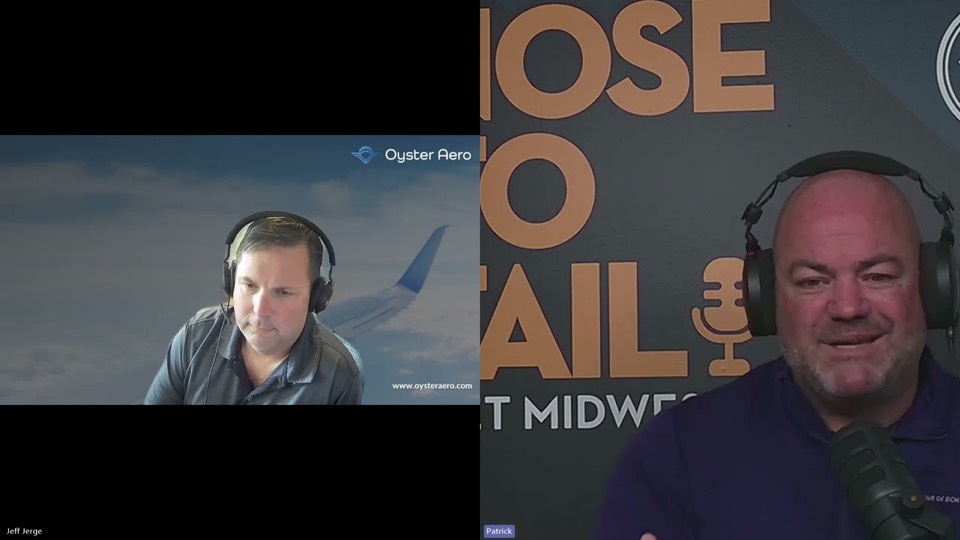
We’re thrilled to have fellow podcaster Patrick Kraus join us for this episode! Patrick walks us through the founding of Jet Midwest, and how the expansion of services through the old TWA/American overhaul base in Kansas City happened. It was great to hear how the company has adapted over the years.
Don’t miss out—check out our latest clip with Patrick.
Transcript
Read the full transcript
From the episode's captions, as published. Words that can't be made out are marked [unclear].
Hello everyone. Jeff Jerge, chief of pearls at Oyster Aero. I'm here with the fellow podcaster Patrick Kraus of Jet Midwest. How you doing today, Patrick? I'm doing fantastic, Jeff. Thanks for the invitation. Yeah, no, no problem at all. We're happy to have you. So, um I guess you're fresh out of uh Ireland for St. Patrick's Day, huh? Yeah. Yeah, I was uh I had a little bit of business travel and then had a little bit of personal travel and was lucky enough to spend St. Patrick's Day in Ireland. Uh, which was a pretty special experience. Yeah, I'm sure it is. Well, I haven't done that yet. That's probably on the bucket list. So, it it is worthwhile doing. That's for sure. Cool. Um, so I I kind of want to on on the podcast, we kind of like, you know, founders of companies and people that run companies. Um, so, so we certainly wanted to have you here. And, you know, it's kind of close to me. I actually used to work for PWA at the overhaul base in 99 I believe for a short term until American bought them. And um that's where you all are right out there at uh KCI. So um why don't you walk us through that a little bit uh Jet West and kind of when you guys started and your location? Yeah. So, um, you know, I'm pretty fortunate that my my partners are my brother and sister. Um, and grew up in a family of entrepreneurs. So, uh, you know, being the risk of business was fairly normal to us. And, uh, and my brother actually, uh, started another aviation company in Southern California in the '9s. And, uh, he was he was buying and selling, uh, a lot of packages and and moving a lot of parts.
And one of the problems he had was the real estate prices in California. uh where his warehouse was was really high. And so he's like, "I want to start an offshoot company." Um and so he called his uh his best friend that he grew up with and said, "Hey, go go go get a warehouse. I'm going to get you this uh this stuff. I'm going to send it to you. You put it on this thing called the ILS and people just call you and buy stuff." And like that was the whole explanation. Uh so that was 1997 that the truck started to flow. Um and then in uh 1999 uh as the material started to stack up and and uh they needed a little bit of support uh my brother called and said hey you know can you come and start moonlighting with us and and helping out with the inventory and helping out trying to understand what's going on in the business and I said sure. Uh so I came in in 99 and uh bought out his partner in uh my sister and I bought out his partner in 2005 and so it's been the three of us since then. Um, it's interesting because you mentioned 99 because that's right when I came in was December of 99 and and uh the very first big package for Jet Midwest, the parts company really was the TWWA material from the American purchase because we were in Kansas City as a uh where our warehouse was. It was very convenient for us to create create a deal with American say we'll take all of the aircraft uh all the engines and all of the parts from all the aircraft that you're no longer going to operate out of that TWWA fleet. So the the DC9s, the L1011s, uh Pratt powered 76s, the 74 material and TWA had a lot of back shops. They were very self-sufficient.
So, even the back shop material, which was some of the best material that we've ever gotten, uh came through uh that deal. It was 70 plus trucks. We just we just had trucks going around in circles for for 6 months uh loading them up on one end and bringing them back. And uh uh that was great until you look back and go, we had seven people in our company and we had 70 trucks to process in a year. It was uh it was quite a journey. Uh that's really right. That's how you cut your teeth in this business is just doing a whole lot. Feet first in and just go. Um so that was that was a really great jump leap for us. Uh the really first mega leap that we took as a company. And then um you know really in the post 911 world um you know with that TWA package we had a lot of expendables. That was really our our key or core competency at the time. And uh in the post 911 world, a lot of the folks who had roables that were really expensive, you know, the per cost per unit was really high and unstable. So uh a lot of the marketplace said, "Hey, let's go get some stable. Let's buy some packages of expendables." This sort of came into our side of the marketplace. And um as that started to get flooded with people with interest, uh we kind of said, "Well, let's do the opposite. Let's go to where they came from and maybe start seeing if we can't uh get some aircraft." We started tearing down aircraft um in the post 911 world and that was I don't know 700 plus airplanes ago. So it's been a an interesting uh 20 plus years of of dismantle work. Um we were very fortunate to you know to be in a city like Kansas City which doesn't have a huge aviation um it's been a long time since it had a huge aviation presence in especially in the aftermarket. uh to have the facility. Uh so Americans started exiting the TWWA overhaul base in uh uh the 2005 through 2008. They started to peel away from uh Kansas City and really move their operations to to Dallas, Tulsa um and basically remove
these operations and and shrink it. So as the um the downturn in the economy in 089 happened, um they were like, "All right, we're out of here. We just can't handle this billing." And uh we we approached the aviation department and said, "Hey, you know, we have an interest in maybe expanding our operation at this time." And so we just did an orderly takeover of the facility um from American. As they left, we kind of rolled in behind them, had great support from our aviation department and really they made a great um strategic play, I think, in in helping invest in Jet Midwest. They were very flexible with us the first handful of years, understanding that we were in a growth pattern. So that was that was good. Um, you know, it was interesting again going to, you know, we had 1.2 million square feet. We had, I think, 17 people in Kansas City at the time. And, uh, you know, uh, today we're we're over 200. So, uh, we've we've fulfilled our promise of growth and aviation jobs and those things. And, uh, if you, if you come up to the overhaul base or anybody lands in Kansas City at the airport, you're going to look over and they're going to see 50 airplanes parked out there. and and um you know I'm very proud to say that you know almost all of those aircraft are here because of what Jet Midwest has done and what we've built towards. So well uh I'm sure if I asked Chat GBT how many parts traders and stockist are in former airline overhaul bases there's can't be many.
So, uh, yeah, it's it it is. And and you know what I love? Um, aviation, you know, once you're in this business, you know, you just get this passion for it. And, uh, you know, Howard Hughes built this facility in the ' 50s and we're still using the exact brick and mortar exactly as it was designed in in the in the 50s and put into place. And he was very forward thinking in how he designed the place. uh the buildings were built 20 years before the airport was finished. So, uh there's a lot of visionary and and I love that historical piece of it and um I think it rubs off on a lot of people. Like you said, you were here for 6 months. Um and uh you know, that was a start of your career. Um there's a there's a great story I was told um by a uh actually a competitor um who does work with Ethiopian. And I didn't realize this until I had talked to him. and I'm sitting in my office and he said, "Oh, I used to be office out of that building." And so he tells me the story that um TWWA helped found Ethiopian Airlines and what they did was they put an agreement together to say we'll build Ethiopian Airlines exactly designed after TWWA and then once it's built the Ethiopians could purchase that back and um so that was a very interesting um concept right so the engineering the training the mechanics, even the fleet types were similar in the engine types and the engine shops and uh and so this, you know, all of these folks from Ethiopia were coming to Kansas City uh to train and to go through all the things as if they were TWWA employees and then they turn around and go back to Ethiopia and set up the same processes there. So, it was a pretty neat journey and it's awesome to listen to that story going, man, that's that's really cool.
Um and explains why we have a an Ethiopian community here that's uh almost you think about being in the middle of the US that that would be an interesting community to get set up and that that's a big reason why it's here is because of that time setting up Ethiopian Airlines through the the junction with uh partnership with TWWA. Yeah, I'd never heard that. That's interesting. So, um you do tearowns out there. Um and then what kind of aircraft are you focused on today? Like what would you say your mix is? Well, certainly our biggest focus these days is the trip 7 um fleet and uh but I would say through our career we've really tried to focus on aircraft that have a second life in uh the freighter market. Uh obviously 75 76 747 um that's really been the majority of the work that we've been involved in and a lot of that was based on we know these are going to have an extra 20 years.
There's a huge investment going into a 767 fleet. They're going to keep those airplanes as long as they possibly can and and hopefully we can watch those airplanes uh continue to grow and and the next wave of airplanes that come through whether the 737s or the A320 uh cargo conversions that are happening and then those aircraft will hopefully stick around for uh an extended period of time. Um but I would say at the same time we are opportunistic and we always have kind of have been. Uh we had the opportunity to purchase some A380s um a couple of years ago and it was it was certainly um a a reasonably high risk. uh we don't look at it that way, but I think the marketplace was gez who's what knucklehead is buy buying A380s when they're all sitting on the ground during co um you know but we we had to put a bet out there that said that those aircraft are going to come back and be have something to sell and be able to monetize and and I think that we've created a deal that was good for us and and we've been able to hold on to those and and put that together. Uh but we've done A320s and A330s. Um 310. So we we do dabble on the other side of the pawns uh product lines. Uh that's probably 30% of our marketplace and the other 70% probably lives in that Boeing world.
Wow. And then so outside of parts trading and tear down, what other business lines are there Jet Midwest? Do you do leasing? Do you do we do asset management? That kind of thing as well. Well, you know, I actually I think and that's a good point because I think as a parts company, as a foundational part of what we do, um it used to be that we were just a parts company and then in when we moved to the overhaul base, we opened a an MRO. Uh actually started with a paint shop. It was a fairly easy certificate. I think our manual was about that thick. Um we could paint airplanes and change light bulbs. Uh and so we did that for a little while because there was a bubble in the market. Um, and that that certificate grew. We did some heavy maintenance there. And today, uh, Jet Midwest Technic is our component shop. Um, and, uh, they're in the the top floor of the, uh, warehousing building that we have. Um, and they're doing, uh, flight services, NELS, um, and really doing a a huge job to help support the balance of what [unclear] does, which is really asset management. Uh we've recently expanded and are doing some um engine uh work. So we've got our engine rating up. So we've we expanded that into an engine shop.
And then uh last year we uh procured an on-site MRO. So now we have the heavy maintenance side. So if you think about asset management, uh Jet Midwest is able to bring in an aircraft and use its heavy maintenance MRO to handle the storage, engine changes, landing gear changes, maybe even C checks if we if that's what the customer demands. Uh then the asset management team says, well, now I can sell it, I can lease it, um and I can move engines and do a lot of different things uh to make this an easier asset to to monetize. So again, I think we've probably transitioned from a parts company and that that really was who we were for the longest time to really now we're just so good at all the little pieces of this that we really have become an asset management focused company. And uh I I tell people that, you know, we work with some consignment partners. I'm like, our company is just a big machine and we're going to shovel aviation assets into it. It doesn't matter what they are. It could be tooling. It could be engines, aircraft parts. you're going to shovel that fuel into our system and that machine will turn on the other side. We'll we'll have revenue coming out. Um and you know, I'm pretty proud of where we've gotten to over, you know, 25 plus years of my career um with the company by being able to create it that way. And and it's not seamless. Nothing is seamless. It's always got, you know, some of those gears don't fit perfectly. Um so it gets a little clunky at times but um we we certainly seem to be producing consistent product um time and time again for our our consignment partners.
Fantastic. So um I guess you know you had mentioned at the beginning back in the day in the '9s you would just you know throw stuff on a marketplace and get orders. So yeah um how have things changed in the last 20 years? Would you say 25 years? Well, I I would certainly say that the um there's a lot of challenges with where you where you list your material because um you know, certainly the the industry uh standard, you know, really drives when you when you think about somebody like the ILS, it it drives people to um it is a a marketplace where people are not necessarily handling transactional uh communication. Um we're out there, you know, we broker parts all the time. Every day we're brokering. Uh but you know, a lot of times we're out there saying, "Geez Louise, the the market conditions are changing. I need to figure out where I stand in the marketplace." And so people are pricing each other. And all of a sudden, that became the pricing tool. And there are some other folks that came out with some different uh formats of of a similar products and and they really didn't meet the needs. Now, the one place with the ILS that um you know, it's it's such a vast marketplace that it's a good starting point to kind of see what's out there, but um a lot of times your your more niche markets are or in some of these other platforms. Um, you know, we used to run I remember our sales team a decade ago and and everybody's like, "Well, you got to run ILS broadcast and do this and if you don't do those things, you're you're not going to be able to get and we just found that that really wasn't how we were selling our parts." Um, and and that that was less effective than we wanted it to be. Um, and I guess from a from a parts company to another parts company, m maybe that's the place where that works well. And we were transitioning away from that to really be uh operator and uh enduser specific. Uh so that was part of our metamorphosis uh that we needed other
resources. Sure. Sure. So um you know I don't think it's any secret. I mean, I I certainly uh worked there for a while and and we're not um you know, we'll get into this on our next podcast, but we're we're we're super different in the sense of our the way we go to market and and channel partner and everything at Oyster. Um so, we definitely uh believe that they absolutely have a a really solid foot place in the industry. Um so, I guess what do you see as in the future, the next couple of years for Jet Midwest? What are you guys focused on as far as um you had mentioned I mean component shop buildout paint you know asset management are are you continuing the same model and and still going out there on widebody do you see any kind of um deviations deviation is a bad word you know additions to the to the core well I I would certainly say um you know the marketplace does dictate a little bit about what assets are available at the right price right when we can always overpay for, you know, a 2012 A321, right? That would be an expensive airplane and is that investment wise there. So I think for us a little bit of it will be hey where where's the marketplace moving and we're going to want to observe that and see that a lot of the reason that the trip 7 um marketplace that that came together was a combination between uh you know COVID conditions and if you look at the fleets when they came back after co the wide bodies were last and you know the narrow bodies came back um and once they did that that created a lot of momentum and all that that domestic travel was what had to start up first and that was a natural thing. And so it was um so again it maybe gave the trip 7 marketplace was maybe more hesitant um to put those back into service because they just didn't know and that's an expensive bird. So that's again kind of where we landed. Um I think we're going to continue to drive uh aircraft uh into our system and continue to shovel that fuel into this big machine and I also
think we probably are ready for some more technology. Um, you know, certainly, uh, everybody's, you know, the buzzword of AI, uh, you know, when we think about what it could do and how can we put that into place, uh, while not losing our edge that we currently have over some of our competitors, right? So, you could replace your customer service with some AI, but is that are you going to lose your edge over your competitor who's making the phone call versus having a machine make it or or or where does that fit? And I think right now we're we're working hard to uh to take something like AI and say how do we put this in place and use this over the coming years to really give us an edge. Um you know we've expanded from uh you know roughly 140 people 18 months ago to 200. So our growth is really high and it'd be great to deploy all those people to and give them some tools like AI so they can increase their productivity. Um, and that'll be an important focus for us here in the in the coming months and as we swing into next year because I really think it's going to take some a while for that to really get our hands around what it is and how we're going to implement it. But I do think uh 26 is going to be uh a big year for us with technology. That's interesting. A lot of people are talking about just what you said, you know, and your relationship with your operator shouldn't be, you know, hand keying quotes, you know, um automation of task is is certainly where the opportunity is. So, well, good Patrick.
It has been really good having you here. I'm looking forward to seeing you all in a couple of weeks out at MRO. Um, I'm sure that you'll be your booth will be buzzing uh especially as you do the inperson Nose tale podcast and then all the other things that you have going on. So, we're looking forward to seeing you and um you know uh we also are ready to help you here at Oyster with packages and anything else that we can you know do to help uh drive efficiencies in the market. So, absolutely. Well, I look forward to having further discussion. And I know our teams have been working together for the last couple of months and uh you know there's certainly next steps for everybody and I'm I'm excited for that because it creates opportunities to service our customers in in one way and to service our consigners in another way and just makes our machine that much better when we can partner with somebody that really understands how to get that those assets moved. Good deal. All right. Well, thanks a lot, Patrick. Thank you, Jeff. I appreciate it. All right.